For buyers searching for OEM ODM garment bags, the real question is not only terminology. It is whether your brand needs a fully specified custom garment bag made to your design, or a supplier-developed base style that can be adapted with your logo, material, color, size, and packaging. OEM is usually better when your team already has a clear tech pack, target dimensions, construction details, and brand requirements. ODM is usually better when you want to start from an existing supplier concept and customize it for a retail, travel, hotel, apparel, or promotional program.
The best route depends on how much control you need, how much development work your team can manage, how soon you need samples, and what details must be confirmed before bulk ordering. For garment bags, the decision often comes down to material, folding structure, zipper quality, handle position, clear window, hanger opening, logo method, retail packaging, and QC expectations.
Great Shine Home Storage Supplier works with buyers sourcing wholesale garment bags and broader OEM/ODM private label bag manufacturing programs. This guide explains how to compare OEM and ODM routes so your RFQ is clearer and your supplier can respond with more accurate suggestions.
What OEM and ODM Mean for Garment Bags
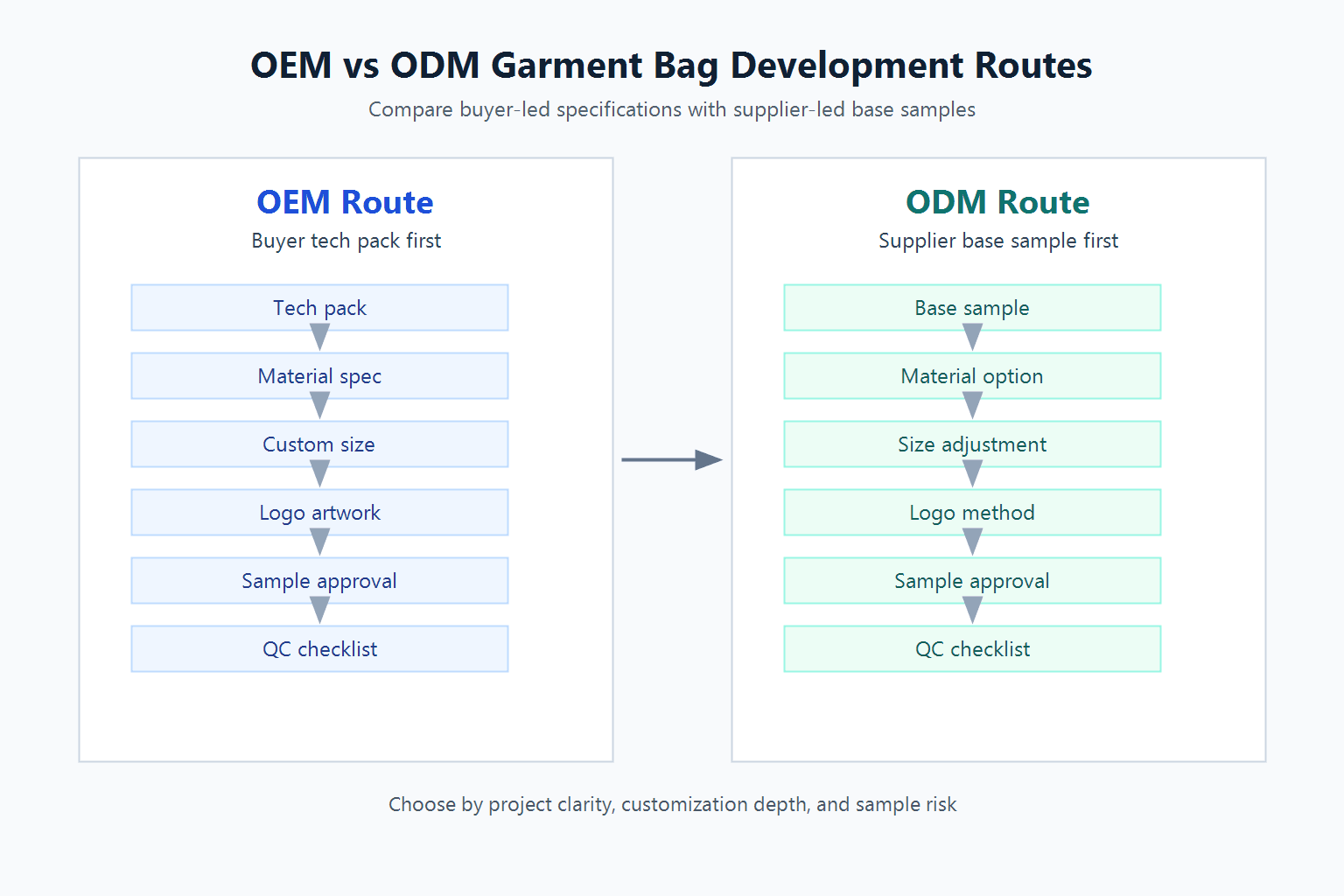
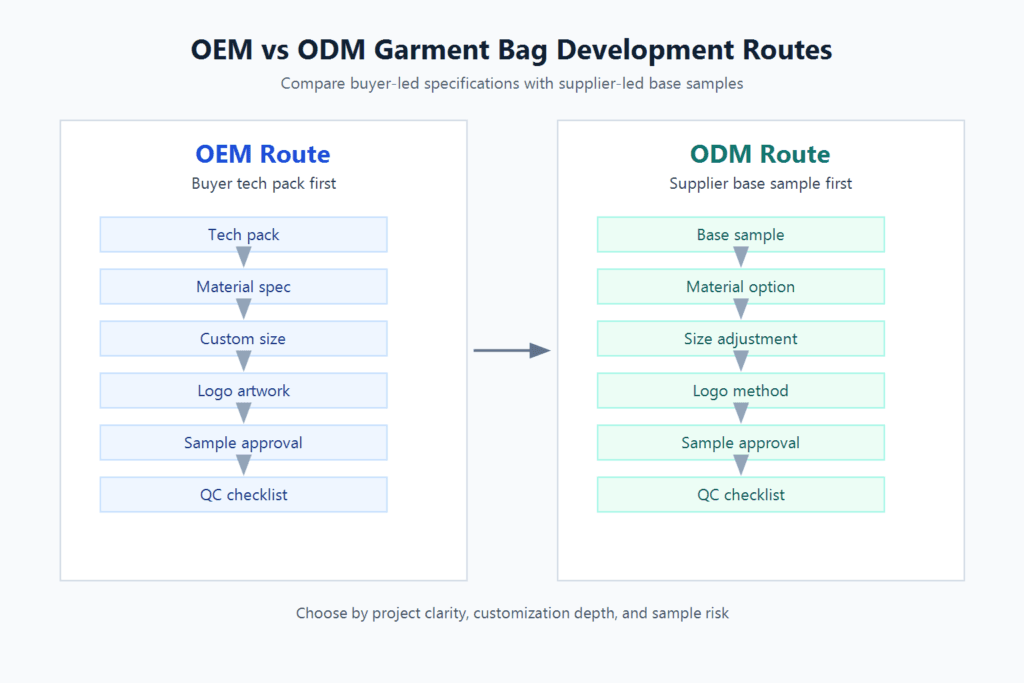
OEM garment bags are produced according to a buyer’s design or specifications. The buyer may provide the size, fabric weight, zipper type, folding style, logo artwork, packaging format, and inspection requirements. The manufacturer then evaluates whether the design can be produced, suggests adjustments if needed, prepares samples, and quotes based on the confirmed specification.
ODM garment bags start from the supplier’s existing product development, sample library, or construction experience. The buyer selects a base style and customizes visible and commercial details such as color, logo, label, material, size adjustment, packaging, or accessory choices. ODM can be useful when a buyer wants a faster starting point or does not yet have a complete design file.
Both routes can support private label garment bag programs. The difference is the starting point. OEM starts from your specification. ODM starts from the supplier’s existing design direction and adapts it for your market.
Quick Comparison: OEM vs ODM Garment Bags
| Decision Factor | OEM Garment Bags | ODM Garment Bags | Buyer Consideration |
|---|---|---|---|
| Starting point | Buyer-provided design or tech pack | Supplier base style or existing sample | Choose OEM for strict design control; choose ODM for faster concept development |
| Customization depth | High, if specifications are clear and feasible | Moderate to high, depending on the supplier’s base options | Confirm which details can be changed before sampling |
| Best for | Apparel brands, luggage brands, retailers with defined programs | Importers, promotional buyers, retailers testing a new category | Match the route to your internal product development capability |
| Sampling process | May require more specification review and revisions | Often starts from an existing sample or similar structure | Ask what sample changes are possible and what details require new development |
| Cost control | Depends on material, size, structure, and custom components | May be easier to estimate from existing styles | Request itemized options where possible |
| Brand control | Strong control over size, materials, logo, packaging, and structure | Strong enough for many private label programs, but within existing design limits | Confirm exclusivity needs separately if relevant |
| Risk points | Incomplete specs, unclear tolerances, untested construction | Over-assuming that every part of a base style can be changed | Use a detailed RFQ and pre-production sample approval |
When OEM Garment Bags Fit Better
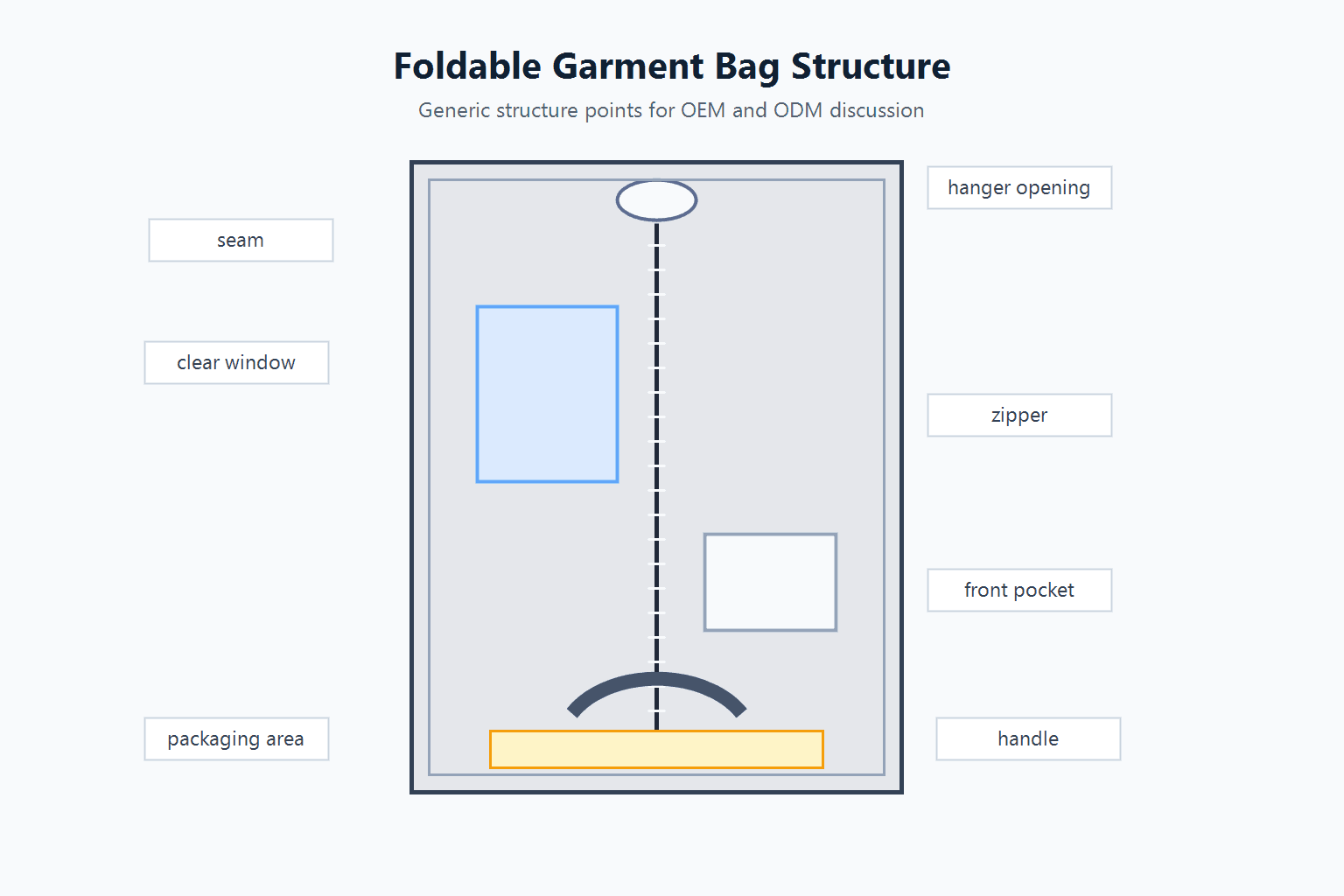
OEM is the better route when your brand already knows what it wants. This may include a specific garment length, gusset depth, pocket structure, foldable travel format, hanger opening, handle placement, zipper direction, or retail packaging style. If your merchandising team has a sample from a previous season, a detailed drawing, or a formal product specification, OEM gives you more control.
OEM also fits buyers who need consistency across a larger retail program. For example, an apparel brand may want garment bags that match suit covers, dress covers, travel organizers, and store packaging. A luggage or travel brand may need garment bags that coordinate with packing cubes, toiletry bags, or duffel bags. In these cases, the garment bag is part of a larger brand system, not a standalone commodity.
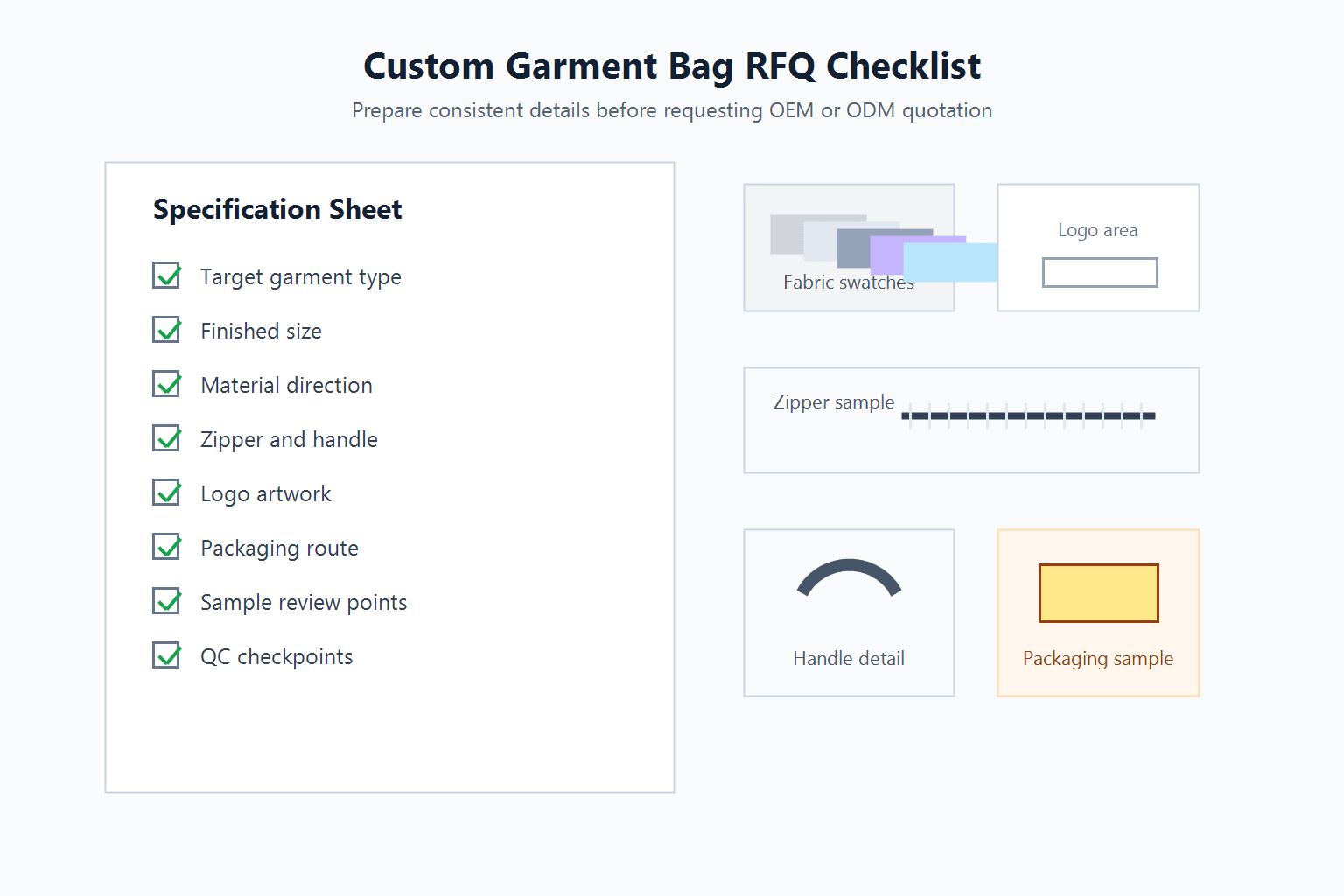
For OEM RFQs, buyers should prepare more than a product name. A strong inquiry includes target size, fabric preference, color reference, logo artwork, closure type, packaging format, estimated order quantity, destination market, and any quality checkpoints that matter for the program. If a detail is still undecided, mark it as open for supplier recommendation rather than leaving it blank.
When ODM Garment Bags Fit Better
ODM is often a practical route when a buyer wants to launch or test a garment bag program without building every detail from zero. Importers, wholesalers, hotels, travel accessory brands, and promotional buyers may know the target use case but not the exact construction. In that situation, an ODM supplier can recommend a base structure and then adapt visible details for the buyer’s brand.
For example, a buyer may ask for a foldable garment bag for travel retail, a non-woven garment cover for apparel packaging, or a reusable suit bag for hotel or event use. The supplier can suggest material options, handle placements, zipper structures, and packaging choices based on available production experience. The buyer still controls important brand details, but the development process begins from an existing direction.
ODM does not mean generic. A good ODM garment bag program can still include private label logo, custom color, adjusted size, packaging inserts, hangtags, labels, and carton marks. The key is to confirm which changes are simple adaptations and which changes require deeper redevelopment, new patterns, special components, or additional sampling.
Key Product Specs to Decide Before Requesting a Quote
Garment bags look simple, but sourcing decisions can change cost, appearance, packing volume, and user experience. Before asking for pricing, your team should decide which specifications are fixed and which are open for supplier suggestions.
Material is usually the first decision. Common garment bag materials may include non-woven fabric, PEVA, PVC, polyester, or other fabric/plastic combinations, depending on the product style and target use. Do not choose material only by appearance. Consider hand feel, opacity, folding behavior, print compatibility, structure, and market expectations.
Size is another major factor. Suit bags, dress bags, coat covers, wedding dress bags, and travel garment bags may require different lengths and widths. Buyers should also confirm whether the garment bag needs a gusset for thicker clothing, a foldable structure, handles, pockets, or a clear window.
Logo and branding choices also matter. Depending on material and design, logo options may include printing, woven label, hangtag, zipper pull branding, or packaging-based branding. The right method depends on the garment bag material, brand positioning, order size, and visual requirements. Ask your supplier which logo methods fit the chosen material before approving artwork.
Packaging should not be treated as an afterthought. Retail buyers may need individual polybags, paper bands, insert cards, barcode labels, display-ready packaging, or carton labeling. Importers and wholesalers may prioritize efficient bulk packing. Private label buyers should confirm packaging early because it can affect sample approval, carton size, and final presentation.
Buyer Checklist for OEM and ODM Garment Bag RFQs
Use this checklist before sending an inquiry to a garment bag manufacturer or supplier:
- Product route: Are you requesting OEM from your own design, or ODM based on supplier recommendations?
- Use case: Is the garment bag for apparel retail, travel, hotel, event, storage, promotion, or private label resale?
- Size: What length, width, gusset, and foldable dimensions are required?
- Material: Which fabric or plastic material do you prefer, and are alternatives acceptable?
- Structure: Do you need handles, zipper, clear window, pocket, hanger opening, reinforced edges, or folding snaps?
- Logo: What logo method do you want, and do you have vector artwork ready?
- Color: Do you need standard colors, matched brand colors, printed patterns, or seasonal assortments?
- Packaging: Do you need retail packaging, barcode labels, hangtags, inserts, or bulk carton packing?
- Quantity: What is your estimated order quantity or annual demand range?
- Sampling: What sample details must be approved before bulk production?
- QC: Which construction points should be checked, such as stitching, zipper function, handle strength, dimensions, logo position, and packing accuracy?
- Market: Are the products for the United States, Europe, Japan, South Korea, or another destination?
Sampling and Approval Questions to Ask
Sampling is where many OEM and ODM garment bag projects become clear. Instead of asking only for a price, ask what kind of sample can be prepared and which details will be final. A reference sample may show structure but not final logo. A pre-production sample should represent the approved material, dimensions, logo, packaging, and workmanship expectations as closely as possible.
For OEM projects, ask whether the supplier needs a physical sample, drawing, measurement sheet, or pattern file. If your design includes special pockets, folding panels, uncommon material combinations, or branded hardware, confirm feasibility before assuming it can move directly to bulk production.
For ODM projects, ask which base samples are closest to your target use case. Then confirm what can be changed. Simple logo and color changes may be straightforward, while major size, material, or structural changes may require new sample development.
Buyers should also ask how revisions are handled. If the first sample is close but needs changes, specify whether the revision is about material, dimensions, logo placement, zipper, stitching, or packaging. Clear feedback saves time and reduces misunderstanding.
Quality-Control Points for Garment Bags
Quality control for garment bags should focus on practical construction details, not unsupported performance claims. Buyers can ask the supplier to check dimensions, seam alignment, zipper operation, handle attachment, logo position, material appearance, folding function, pocket placement, window clarity if applicable, and packaging accuracy.
For private label programs, consistency matters. The approved sample should become the reference for bulk production. If your order includes multiple sizes or colors, confirm whether each variation needs separate sample approval. For retail programs, packaging and label accuracy can be just as important as the bag itself.
Buyers should avoid vague QC requests such as “good quality” or “premium quality.” Instead, describe what must be inspected. For example: zipper opens smoothly, logo is centered within the approved tolerance, garment bag length matches the confirmed specification, handles are attached in the approved position, and individual packaging follows the confirmed packing method.
How to Choose the Right Route for Your Brand
Choose OEM if your brand has a fixed design, strong merchandising requirements, or a product line that must match other branded items. OEM gives your team more control, but it also requires clearer specifications and more careful sample approval.
Choose ODM if your team wants a faster development starting point, needs supplier suggestions, or is testing a garment bag category. ODM can reduce early decision pressure, but you still need to confirm customization limits and avoid assuming every detail is flexible.
Some buyers use both routes. A retailer may begin with an ODM garment bag to test demand, then move to an OEM version for a larger seasonal program. An importer may use ODM for standard garment covers and OEM for a premium travel garment bag with special pockets and retail packaging. The right route is the one that matches your control needs, timeline, and internal product development resources.
How Great Shine Can Support Garment Bag Buyers
Great Shine supports buyers sourcing custom garment bags for wholesale, private label, travel, apparel, storage, and retail programs. Buyers can also review a sample product such as this foldable customized garment bag supplier page to understand possible product direction, then request supplier guidance for material, structure, logo, and packaging options.
If your project includes multiple bag categories, the broader custom bag manufacturer page may help your team compare garment bags with packing cubes, cosmetic bags, toiletry bags, cooler bags, and storage bags. For private label projects, the OEM/ODM private label bag manufacturing page explains how brand buyers can think about materials, logo, labels, packaging, samples, and production coordination.
Request a Quote
If you are comparing OEM vs ODM garment bags for an upcoming retail, travel, hotel, apparel, or private label program, prepare your target use case, size, material preference, logo artwork, packaging needs, estimated quantity, and destination market. Then contact Great Shine to request a quote and ask which customization route is more practical for your project.
A clear RFQ helps the supplier respond with better material suggestions, sample direction, packaging options, and cost factors. Even if some details are not final, listing your open questions gives the manufacturer a stronger basis for recommendation.
FAQ
What is the difference between OEM and ODM garment bags?
OEM garment bags are made from the buyer’s design or specification. ODM garment bags start from a supplier-developed base style that can be customized for material, color, logo, size, and packaging depending on the project.
Is OEM or ODM better for private label garment bags?
OEM is usually better when your brand needs strict design control. ODM is often better when you want a faster starting point and supplier recommendations. Both routes can support private label branding if logo, label, and packaging details are confirmed.
What should I include in a garment bag RFQ?
Include the use case, size, material preference, structure, logo method, color, packaging, estimated quantity, destination market, sample expectations, and QC checkpoints. If details are undecided, ask the supplier to recommend options.
Can garment bag packaging be customized?
Packaging can often be customized for private label or retail programs, depending on the chosen product and order requirements. Buyers should confirm options such as individual bags, inserts, hangtags, barcode labels, carton marks, and retail-ready formats with the supplier.
What quality checks matter for custom garment bags?
Important QC points include dimensions, stitching, zipper function, handle position, logo placement, material appearance, folding function, pocket placement, and packaging accuracy. Ask the supplier which checks are suitable for your confirmed specification.
When should I contact a garment bag manufacturer?
Contact a manufacturer when you know the target product use, buyer market, estimated quantity, preferred customization level, and required packaging. Early contact is useful if you need help choosing between OEM and ODM routes.