OEM vs ODM Storage Baskets: Which Customization Route Fits Your Brand?
For buyers searching for OEM ODM storage baskets, the real question is not only what the letters mean. It is which development route will help your brand launch the right storage basket, fabric bin, diaper caddy, laundry basket, or home organizer with the right level of design control, cost control, sampling work, packaging detail, and quality consistency.
In simple terms, OEM is usually the better route when your brand already has a defined product concept, size, structure, material direction, artwork, and target retail positioning. ODM is usually better when you want to start from an existing manufacturer-developed style and adjust the material, color, logo, packaging, or small structure details for your private label program.
For retail buyers, importers, wholesalers, and private label brands, the decision affects sample development, quotation accuracy, tooling or pattern work, packaging planning, QC checkpoints, and launch timing. A supplier such as Great Shine Home Storage Supplier can help buyers compare both routes across storage baskets and related home organization products before confirming a quote.
What OEM and ODM Mean for Storage Baskets
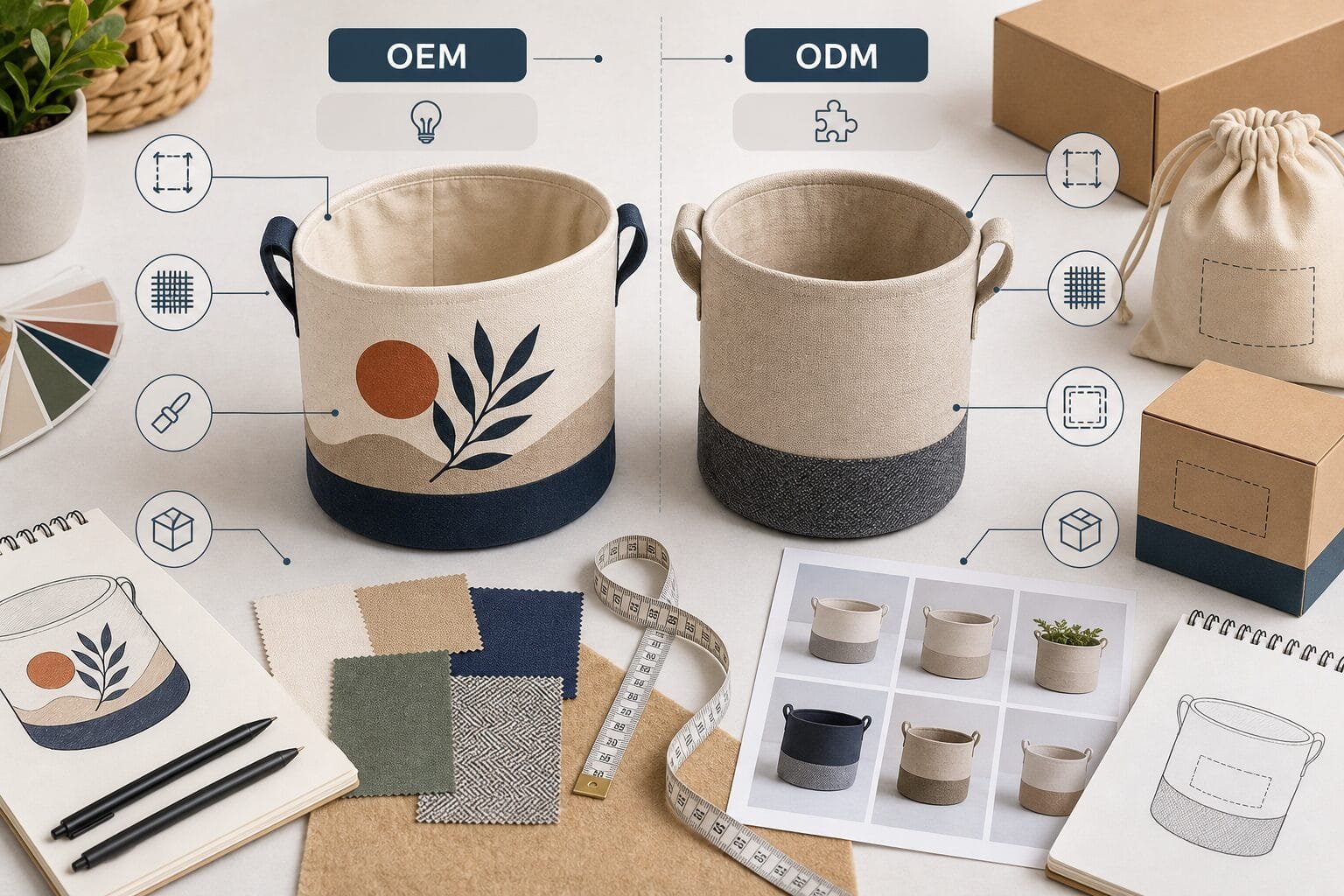
OEM stands for original equipment manufacturing. In a storage basket project, this usually means the buyer provides a specific product direction and asks the manufacturer to produce it according to agreed specifications. The buyer may define the dimensions, shape, fabric, handles, frame structure, lining, divider layout, color, logo placement, packaging, and retail requirements.
ODM stands for original design manufacturing. In this route, the supplier already has a developed product base or existing product concept. The buyer chooses a suitable style and customizes it for a market, brand, or retail channel. Common ODM adjustments include fabric color, print pattern, logo label, handle style, insert card, hangtag, polybag, carton mark, and packaging format.
For storage baskets, the route is not always strictly one or the other. Many projects sit between OEM and ODM. A buyer may begin with an ODM fabric storage bin, then request a custom size, stronger handle, different divider layout, or branded packaging. That hybrid approach can be useful when the buyer wants faster development than a fully new design but still needs a product that feels brand-specific.
Quick Recommendation by Buyer Scenario
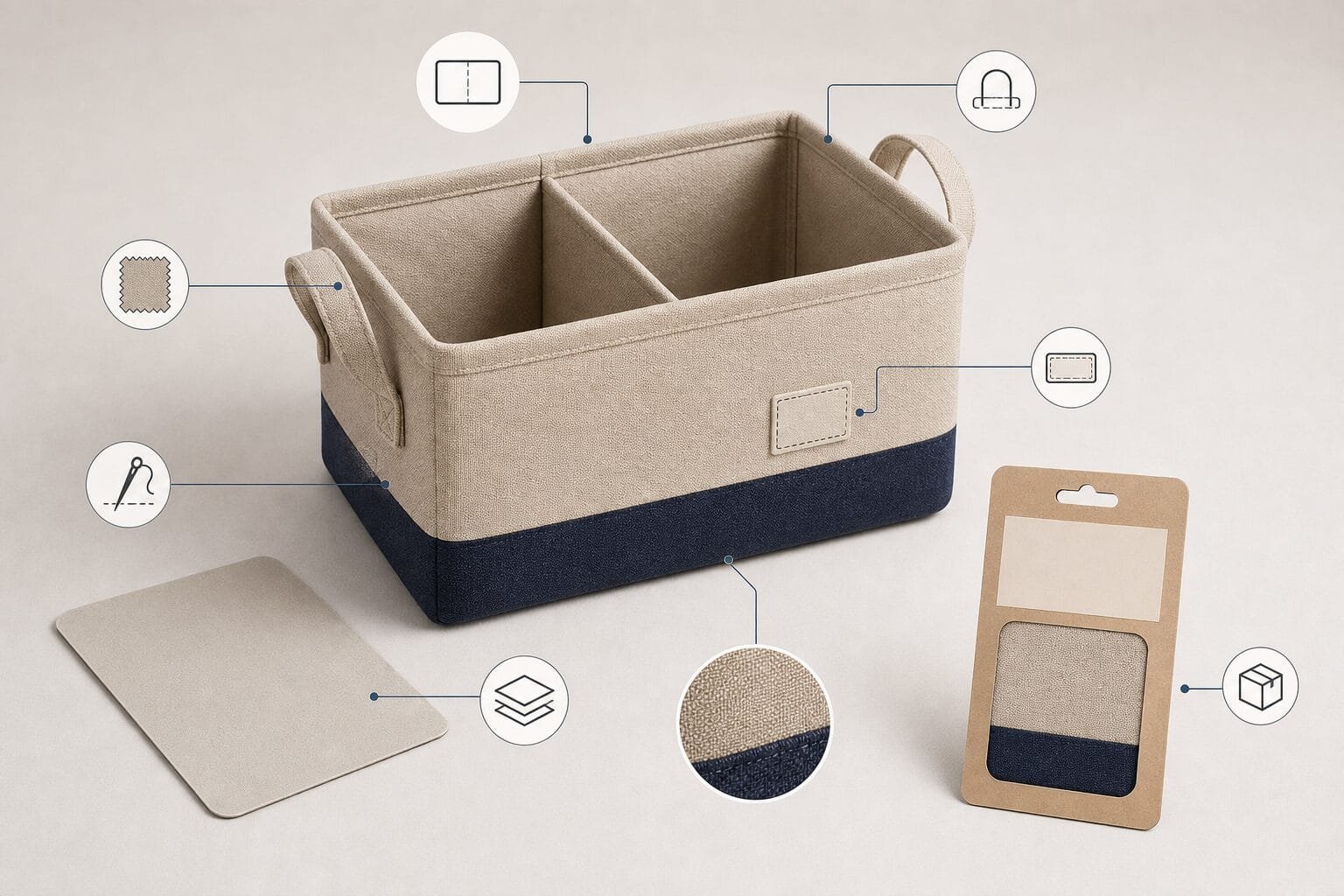
Choose OEM when your team needs a unique basket shape, a specific shelf dimension, a coordinated retail collection, or a product structure that is not already available from the supplier. OEM is also useful when the storage basket must match a planogram, brand design system, baby category requirement, laundry room collection, or home organization set.
Choose ODM when your main priority is to adapt a proven basket style for a private label or wholesale program. ODM works well for buyers who need a practical storage product with brand colors, logo, packaging, and moderate structure changes without developing every detail from zero.
If you are not sure, send the supplier a target product photo, estimated size, order market, material preference, expected quantity range, packaging requirement, and any retail compliance questions that your team must verify. Great Shine’s OEM/ODM private label bag manufacturing page is a useful starting point for understanding how private label development is normally discussed.
OEM vs ODM Storage Baskets Comparison
| Decision Point | OEM Storage Basket Route | ODM Storage Basket Route | What Buyers Should Confirm |
|---|---|---|---|
| Product concept | Buyer provides a more detailed concept or specification | Supplier provides an existing base style for customization | Is the target design new, partly modified, or based on an existing item? |
| Customization depth | Higher control over size, structure, material, pockets, dividers, handles, and packaging | Faster customization of color, logo, label, packaging, and limited structure details | Which features must be unique for your brand or retailer? |
| Sampling work | More sampling discussion may be needed because more details are custom | Sampling may be simpler if the base style is already developed | What sample changes are allowed before bulk confirmation? |
| Cost factors | Pattern work, material selection, construction complexity, and packaging can affect cost | Existing construction may reduce development uncertainty | Which parts affect quote most: fabric, frame, lining, logo, packaging, or carton? |
| Launch planning | Better for differentiated retail programs and exclusive collections | Better for faster private label or wholesale programs | What is the required shelf date or buying season? |
| QC focus | Confirm dimensions, load use, stitching, frame, handle strength, fabric, and packaging | Confirm customized details match approved sample and artwork | What inspection standard and AQL requirement does your company use? |
| Best fit | Brand-owned product, coordinated collection, retailer-exclusive SKU | Private label adaptation, catalog-based wholesale item, promotional or seasonal program | Does your buyer need uniqueness, speed, or both? |
This table should not replace a supplier quote. It should help your sourcing team prepare better questions before requesting one.
Key Product Specs to Define Before Asking for a Quote
A storage basket may look simple, but small specification choices can change material usage, structure, packing volume, and perceived quality. Before asking for a quote, define the product as clearly as possible.
Start with the product type. Are you sourcing a fabric storage bin, collapsible basket, bamboo laundry basket, diaper caddy, drawer bin, closet organizer, toy storage basket, or general home storage box? Each product type has different structure and packaging questions.
Next, define the size and use case. Retail buyers should confirm whether the basket is intended for shelves, nursery rooms, closets, laundry rooms, kids’ toys, bedding, documents, craft items, or general household organization. For example, a baby diaper caddy category may require different compartment, handle, and portability discussions than a closet storage bin or laundry basket.
Material is another key decision. Buyers may discuss fabric weight, non-woven fabric, polyester, canvas-like materials, felt-like materials, bamboo elements, clear PVC panels, lining, cardboard or PP board support, metal frame components, and handle reinforcement. Use these as discussion points, not as fixed assumptions. The correct material depends on price target, retail positioning, folded or rigid structure, expected use, and packaging method.
Color and branding should also be prepared early. If your brand requires a Pantone color, printed pattern, woven label, sewn label, patch, embroidery, screen print, heat transfer, insert card, hangtag, belly band, or custom carton mark, include those in the RFQ. Artwork requirements should be confirmed with the supplier before sample development.
Customization Choices That Affect OEM and ODM Decisions
The deeper the customization, the more the project moves toward OEM. A new basket size, new panel construction, special divider, exclusive handle layout, or coordinated family of products usually requires more specification work. This can be the right choice when the product must fit a retailer’s range plan or when the buyer wants a distinctive private label collection.
ODM customization is usually more efficient when the buyer accepts an existing base shape. You might change fabric color, logo label, packaging, or small functional details while keeping the original construction. This can work well for importers or wholesalers building a seasonal home organization line where speed, cost clarity, and practical function matter more than a fully exclusive shape.
Packaging can also push the decision. A simple bulk carton program may be easy to quote, while retail-ready packaging requires more information: folded size, insert card, hangtag, printed bag, display box, master carton, barcode position, carton marks, and market-specific labeling requirements. Ask the supplier what packaging formats are possible for the chosen structure before confirming artwork.
MOQ, Sampling, and Development Questions to Ask
Because exact MOQ, sample time, and production lead time depend on product structure, material, artwork, quantity, and factory schedule, buyers should avoid assuming one fixed answer. Instead, ask targeted questions during RFQ.
Important questions include:
- What MOQ applies to the selected basket style, material, color, logo method, and packaging?
- Is the project based on an existing ODM style or a new OEM pattern?
- What information is required to make an accurate sample?
- What sample cost, sample revision process, and sample approval steps should be expected?
- Which materials are available for the target price level and market positioning?
- Can the size, divider, handle, label, and packaging be adjusted for a private label program?
- What artwork files are required for logo, print, label, and packaging?
- What bulk production schedule can be confirmed after sample approval and order details?
- What QC checkpoints will be used before shipment?
These questions help both sides avoid vague quotations. They also help the supplier recommend whether OEM, ODM, or a hybrid route is more practical.
Quality-Control Points for Storage Basket Programs
For storage baskets, QC is usually about consistency, function, finish, and packaging accuracy. Buyers should confirm what will be checked rather than asking for unsupported performance claims.
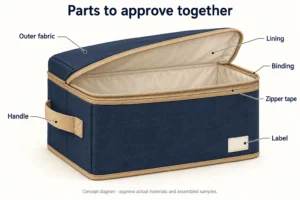
Useful QC checkpoints include dimension tolerance, fabric appearance, color consistency, stitching, binding, handle attachment, divider alignment, folding structure, frame or board placement, label position, print clarity, packaging accuracy, barcode placement, carton mark accuracy, and final packing quantity.
If the basket is intended for heavier household storage, buyers should discuss the expected use case and ask the supplier how the handle, side panels, bottom support, and seams will be designed. Avoid relying on generic words such as strong, durable, or premium without defining what the product must hold, how it will be displayed, and how the retailer will inspect it.
For private label orders, the approved sample should become the reference for bulk production. Any change in fabric, color, logo method, packaging, or size should be documented before mass production. This is especially important for US, European, Japanese, and South Korean buyers where packaging accuracy, retail presentation, and specification discipline can affect acceptance.
Buyer Checklist Before Choosing OEM or ODM
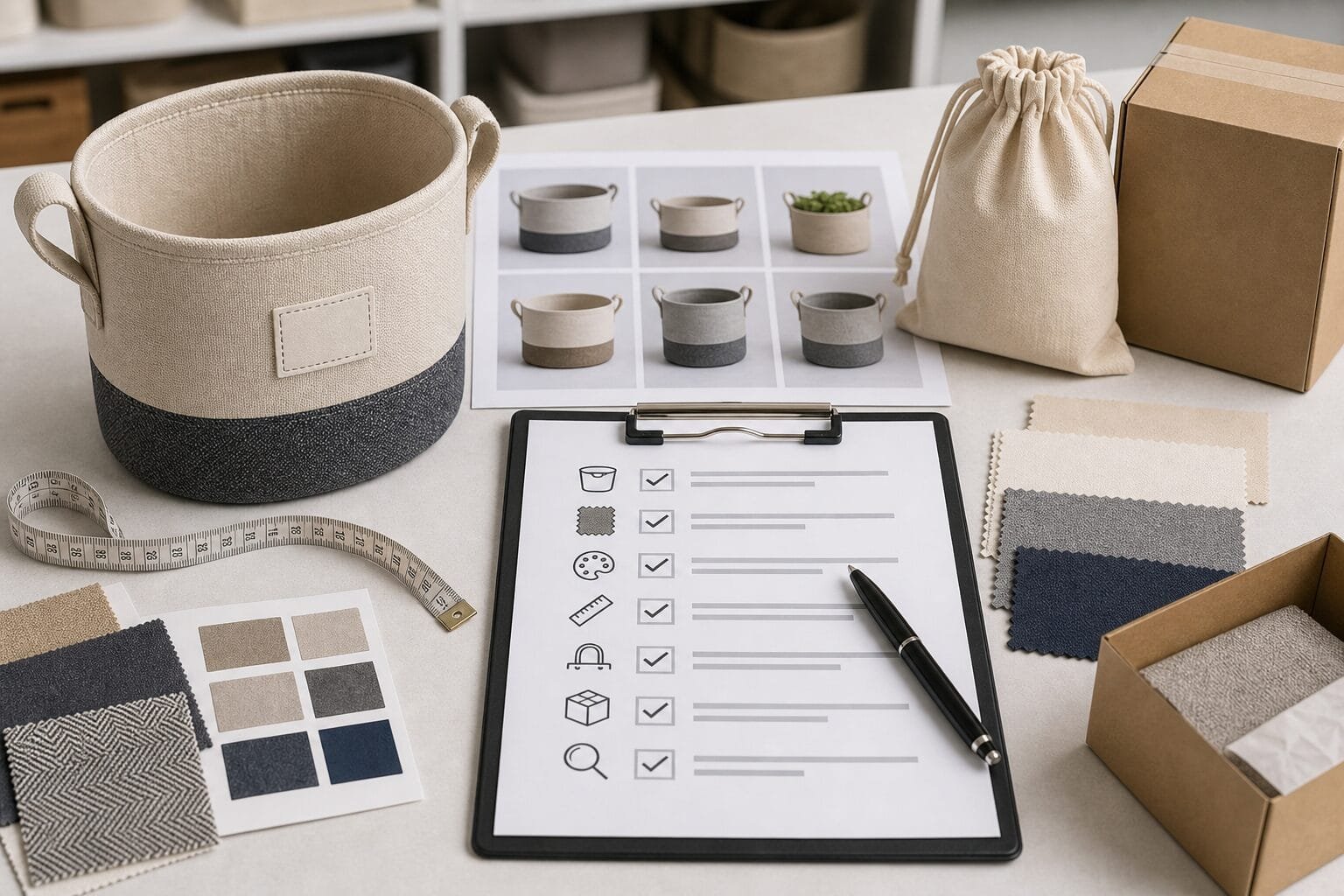
Use this checklist before sending your RFQ to a storage basket manufacturer or supplier:
- Define the product type: fabric bin, storage basket, laundry basket, diaper caddy, drawer bin, toy organizer, or related storage product.
- Confirm the target market: United States, Europe, Japan, South Korea, or another sales region.
- Prepare the target size, capacity direction, or shelf/display requirement.
- Decide whether the shape must be exclusive or can start from an existing supplier style.
- List material preferences and acceptable alternatives.
- Specify whether the product must be foldable, rigid, framed, divided, lined, or easy to pack flat.
- Provide logo method preferences and artwork files if available.
- Confirm packaging needs: bulk packing, polybag, hangtag, insert card, belly band, display box, carton marks, or other retail packaging.
- Ask which MOQ applies to your selected material, color, logo, and packaging route.
- Ask what sampling steps are needed before bulk production.
- Confirm QC checkpoints for size, stitching, handle, frame, label, print, and packaging.
- Share quantity range and launch timeline as planning inputs, not assumptions.
A clear checklist helps the supplier quote the correct version of the product instead of guessing from a broad product name.
When OEM Is the Better Route
OEM is the stronger route when your brand needs a storage basket that fits a specific retail program. For example, a retailer may need a collection of bins in several sizes with matching fabric, coordinated label placement, and packaging that fits a display plan. A nursery brand may need a diaper caddy with a particular divider layout and carry handle. A home organization brand may want a basket family that matches its existing closet, laundry, and shelf storage products.
OEM also makes sense when your buyer has a clear product brief. That brief may include sketches, reference samples, measurement drawings, fabric targets, color standards, label requirements, packaging artwork, and inspection requirements. The more complete the brief, the easier it is for the manufacturer to evaluate feasibility and quote accurately.
The tradeoff is that OEM usually requires more confirmation. More custom details mean more sample decisions and more chances for specification changes. That is not a problem if your sourcing team is prepared, but it should be built into the development process.
When ODM Is the Better Route
ODM is often better for buyers who need a practical private label storage basket without building a completely new product. Importers, wholesalers, and retail buyers may choose an existing basket or bin style, then customize the color, logo label, packaging, or small details.
This route can be useful when testing a category, building a seasonal storage line, or filling a product gap quickly. It may also help buyers compare material and packaging options before investing in more unique OEM development.
The limitation is differentiation. If the base product is widely available, your brand may need stronger color direction, packaging, merchandising, product set planning, or added details to create a more distinctive offer. Ask the supplier what can be changed without turning the project into a full OEM development.
How Great Shine Can Support the RFQ Discussion
Great Shine works with custom storage bags, storage boxes, fabric storage bins, baskets, closet organizers, packing cubes, garment bags, makeup and toiletry bags, and related home organization products. Buyers can review Great Shine’s storage products for retailers and custom bag manufacturer pages to identify the closest product family before preparing an RFQ.
For an OEM or ODM storage basket inquiry, send as much of the following information as possible: product type, reference photos, target dimensions, material preference, color, logo method, packaging requirement, quantity range, target market, and any buyer inspection or retail packaging requirements. If some details are not confirmed yet, state that clearly and ask for supplier recommendations.
When your team is ready, use the contact page to request a custom quote. A clear RFQ allows Great Shine to respond with more relevant customization suggestions and helps your team compare OEM and ODM routes with fewer revisions.
FAQ
Is OEM or ODM better for private label storage baskets?
OEM is better when your private label brand needs a unique size, structure, material combination, or retail collection. ODM is better when you want to customize an existing supplier style with your logo, color, packaging, or smaller adjustments.
What information should I send for an OEM storage basket quote?
Send the product type, target size, reference photo or drawing, material preference, color, logo method, packaging requirement, quantity range, target market, and any QC or retail packaging requirements your buyer needs to confirm.
Can ODM storage baskets still use custom branding?
Yes. ODM storage baskets can often support private label branding such as logo labels, printed artwork, hangtags, insert cards, custom packaging, and carton marks. The available options should be confirmed with the supplier for the chosen style.
Does OEM always require a higher MOQ than ODM?
Not always. MOQ depends on the material, color, logo method, packaging, structure, and order details. Buyers should ask the supplier to confirm MOQ for the exact specification rather than assuming one fixed number.
What QC points matter most for wholesale storage baskets?
Common QC points include size, fabric appearance, color consistency, stitching, handle attachment, divider placement, frame or board structure, label position, print clarity, packaging accuracy, carton marks, and final packing quantity.
When should I request a quote from Great Shine?
Request a quote when you have a target product type, size direction, material or style preference, branding needs, packaging requirements, and estimated order quantity. If you are still comparing OEM and ODM routes, include that question in the inquiry so the supplier can recommend a practical development path.
Request a Quote
If your team is comparing OEM and ODM routes for storage baskets, fabric bins, diaper caddies, laundry baskets, or related home organization products, prepare your product brief and request a custom quote from Great Shine. Include your target market, product type, size, material preference, logo, packaging, and quantity range so the supplier can recommend a practical customization route.