A mirror jewelry box combines jewelry storage with a mirror, although some designs use mirrored panels mainly for decoration. Choose one by checking the space inside, the mirror’s viewing angle, and the room needed to open it. Rings need suitable slots, necklaces need room to stay separate, and raised settings need clearance below the lid. For daily dressing, consider a tabletop box with a mirror you can see comfortably from your usual position. A small travel case suits a limited selection of jewelry, while a large mirror cabinet needs a separate space and installation check.
Before choosing a finish, lay out the jewelry you plan to store. Include the pieces that cause problems now: the chain that tangles, the watch that crowds a drawer, or the earrings whose backs disappear into a deep tray. Those details tell you more about the right box than a photograph of an empty interior.
For home use, the choice will depend on your dressing space and daily routine. Travel adds other needs, such as a secure closure and protected mirror. The sections below explain the details to compare before you buy.
What does a mirror jewelry box include?
The term can describe a jewelry box with a useful mirror inside, a box covered in decorative mirrored panels, or a larger cabinet with a mirror door. Product names do not always distinguish them, so check the open and closed photographs before comparing prices.
A jewelry box with a mirror inside
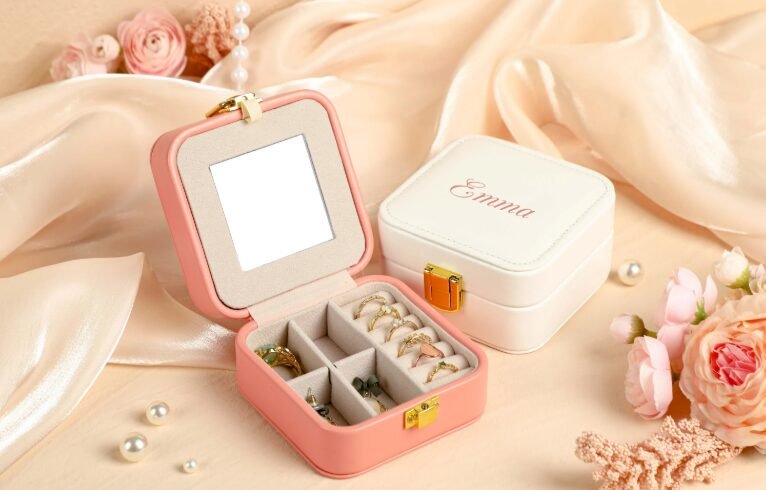
This design usually places the mirror under a hinged lid or on a folding panel. It lets you check earrings, a necklace, or other small accessories while reaching into the storage compartments.
Its usefulness depends on where the box sits. A fixed mirror that works on a tall dresser may point below your face when the same box sits on a low vanity. If you plan to use it while seated, check the viewing position at that height.
A lid mirror also shares space with the contents when the box closes. Tall rings, large brooches, or overfilled compartments should not press against its surface.
A box with a mirrored exterior
A mirrored jewelry box may have reflective panels on its sides and lid, with no usable dressing mirror inside. People often choose this style for its appearance on a dresser or shelf.
Look for separate photographs of the interior. An attractive exterior does not tell you whether the box has dividers, ring rolls, or a simple open compartment. Decorative bevels and antique effects can also make a surface less useful for checking small details.
If you already have a dressing mirror nearby, the reflective exterior may be enough. Otherwise, look for an interior mirror as well and assess it separately from the decorative panels.
A mirror jewelry cabinet
A cabinet or armoire provides a different scale of storage, often behind a larger mirror. It can suit a collection with many necklaces or a dressing area that needs a full-length view.
Its requirements extend beyond a tabletop box. Floor space, door clearance, mounting, and stability become part of the purchase. If that is the format you need, compare dedicated cabinet specifications and follow the supplied installation instructions. Do not assume that advice for a portable box also covers a wall-mounted unit.
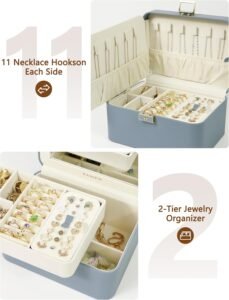
What size mirror jewelry box do you need?
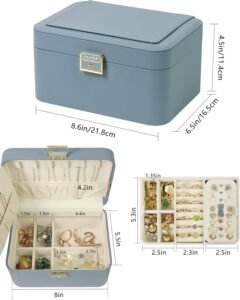
Choose the smallest box that holds your intended collection without crowding it and still leaves useful access to each compartment. External measurements establish whether it fits the room; internal measurements establish whether it fits your jewelry.
Start with the collection you will use
Separate daily pieces from occasional ones. You may find that a small box can hold everything you wear during the week, while less-used items can remain in their individual cases.
Count your earrings in pairs and note their shapes. Small studs and large hoops each count as one pair, but hoops need a wider storage space.
Set aside bulky bracelets, pendant necklaces, and watches. These often determine the minimum depth or width of a useful compartment. If a listing gives only the number of storage sections, ask for the dimensions of the largest section.
Leave some flexibility if your collection changes. Removable dividers or an open lower tray may provide more useful growth space than additional narrow ring slots.
Measure the box where it will stand
Measure the available width and depth on your dresser or vanity. Include anything that will remain beside it, such as a lamp or an existing makeup organizer.
Then check the open dimensions. A hinged lid needs room behind or above the box. Drawers need space in front, and side-opening compartments need room at the edges.
A paper outline of the closed base can help you judge the footprint. Use another piece of paper to mark the drawer extension or the area needed for the lid. This is especially useful on a narrow shelf where the closed box appears to fit comfortably.
If the box will live inside a drawer, measure the drawer’s usable opening as well as its interior. Handles, rails, or an overhanging frame can reduce the space available for lifting the box out.
Check the depth above each tray
A deep box can still have shallow individual compartments. Look for the space between the base of a tray and the surface directly above it.
This matters for raised ring settings, cuff bracelets, and watch faces. Jewelry should not keep the lid from closing or bear the weight of an upper tray.
For a removable tray, check where you will place it while reaching the level below. A layered box can become inconvenient if every use requires clearing another surface. Drawers may be easier when you expect to use several levels every day.
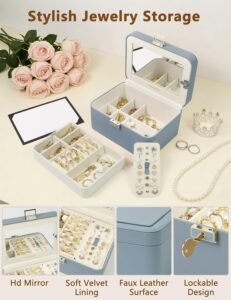
Which compartments will work for your jewelry?
Match the interior to the shapes you own. A mixed layout is useful only when its sections have the right dimensions and remain accessible after the box is filled.
Rings and narrow bands
Ring rolls hold bands between padded rows and keep them visible. Check the spacing and firmness of those rows, especially if you wear wide bands or rings with large settings.
A ring should sit securely without being forced into a tight gap. Its setting also needs enough clearance under the mirror or tray above.
If you own only a few rings, a large block of fixed ring rolls may waste space. A removable insert lets you use the same area for another type of jewelry later.
Studs, hoops, and drop earrings
Small divided sections can keep pairs together, including their backs. Avoid a layout that requires you to search through several layers of loose earrings to find a matching pair.
Earring cards or pierced panels may work well for studs, but check how you reach the backs. A panel that must be removed each time can slow down a daily routine.
Hoops and drop earrings need wider or longer spaces. Compare their dimensions with the compartments, including the hooks or posts. A display photograph filled only with tiny studs cannot show whether your larger earrings will fit.
Chains and pendant necklaces
Necklaces need a place where separate chains stay apart. Depending on the design, that may mean individual channels, hooks with lower pockets, or separate small pouches.
For a box with lid hooks, inspect the full route of a hanging necklace. Check where the pendant rests and whether the chain can enter the hinge area when the lid closes.
The longest usable storage path matters more than the number of hooks. Several closely spaced hooks may still leave delicate chains touching or gathered in one pocket.
Bracelets, watches, and larger pieces
Rigid bangles need an open compartment with enough width. A shallow grid designed for earrings may leave them standing upright against the lid.
Watch pillows can keep watches in place, but their size should suit the strap or bracelet. Confirm that the pillow fits inside the compartment with the watch around it and that the watch face remains clear of the level above.
Brooches and pendants also benefit from individual spaces. Position them so exposed pins and edges do not catch the lining or neighboring pieces. If several items need their own pouches, include those pouches when checking capacity.
Pieces that already have their own cases
Keep a fitted case when it supports an unusual shape or provides storage instructions specific to the piece. A large jewelry box does not need to replace every original container.
Measure the case if you want to store it inside the larger box. Otherwise, reserve the main organizer for the items it handles well. This can be more convenient than rearranging an entire collection around one oversized piece.
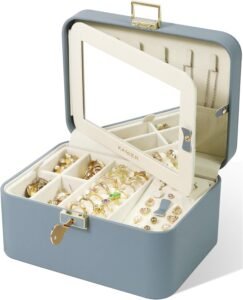
How can you tell whether the mirror will be useful?
A useful mirror gives a clear view from your normal seated or standing position and stays in that position while you use it. Size alone cannot establish either of those things.
Check the angle at your furniture height
Place a similar object on the surface where the box will stand and consider your line of sight. Product photos taken from above can make a lid mirror appear easier to use than it will be from a chair.
An adjustable mirror can help when several people use the box or when you move it between surfaces. Check how the adjustment holds. A mirror that drifts downward or a lid that needs one hand to stay open defeats much of the convenience.
For a fixed-angle lid, look for a side photograph or a short video. Ask whether the lid has a stay, strap, or other support, and whether that support sets a fixed opening angle.
Look at the reflection and its surroundings
Inspect the mirror from the distance at which you will use it. Look for an image that remains clear across the area needed to see your face and jewelry.
The mirror should sit securely in its frame, with no chipped edges or rough points where you might touch it. Measure the reflective area inside any decorative border, which can make a large lid’s usable mirror much smaller.
Consider what will reflect behind you. A bright window directly behind your head may make it harder to see earrings clearly. Try the intended position with an existing small mirror before deciding whether built-in lighting is necessary.
Decide whether magnification adds value
Magnification can help with small details, but you usually need to move closer to the mirror. That may be awkward if a deep box sits between you and the reflection.
Check whether the mirror provides a standard view as well as magnification. A magnifying surface alone may be inconvenient for seeing how a necklace sits with clothing.
If you already have a suitable vanity mirror, the box’s mirror can be a secondary feature. In that situation, spend more attention on the storage layout and ease of opening.
Which materials and lining should you choose?
Judge the outer finish, structural body, and interior lining separately. A description such as “leather look” or “wood finish” may describe only the visible surface.
Understand what supports the box
Ask what the main body is made from and how the exterior is attached. A covered box may use board beneath fabric or synthetic leather, while a wood-look box may use veneer or another decorative layer.
No single material description proves good construction. Examine corners, joints, and the way the lid meets the base. A well-fitted interior matters even when the outside will spend most of its time inside a drawer.
For mirrored panels, inspect the exposed edges and the transition between glass and trim. Consider how often you will lift or move the box. A decorative box that stays on one surface has different handling needs from a travel case.
Choose a finish you can maintain
Read the care instructions before purchasing, especially if the box combines several materials. The method suited to its mirror may not suit the surrounding fabric or coated exterior.
Light-colored covers make some marks easier to see, while highly reflective surfaces show handling marks clearly. These are practical considerations if you will open the box with lotion or makeup on your hands.
Check the base too. Feet or a soft bottom layer should sit evenly on your furniture. A box that rocks may be frustrating when you pull a drawer or adjust the mirror.
Inspect the lining beyond its color
Look for a smooth, clean interior with no exposed staples, rough seams, or hardened glue near the jewelry. Run a finger gently along accessible edges before placing delicate pieces inside.
The lining should lie neatly inside the compartments. Loose folds can catch an earring post, while gaps around an insert can allow small parts to fall underneath.
A soft feel does not tell you everything about the material. If the listing uses terms such as velvet or suede, check whether it identifies the fabric and any claimed treatment. Ask separately about anti-tarnish properties if those matter to your collection.
Choose a color that helps you see small items
A lining that contrasts with your jewelry can make small earrings and backs easier to locate. Compare the available colors with the pieces you own, including the smallest parts.
Dark recesses may hide dark pieces; pale lining may make some marks more visible. An evenly lit interior and shallow, accessible sections can matter as much as the color.
An unfilled interior photograph in ordinary light will show seams and dividers that display jewelry can hide. Ask for one if the listing includes only styled images.
Will the box protect jewelry from scratches and tarnish?
Separate compartments can limit contact between pieces, but a mirror jewelry box does not automatically prevent tarnish. Physical separation, lining, and storage conditions address different risks.
GIA recommends suitable individual boxes or pouches and describes padded ring slots and necklace posts as useful storage features. It also notes that light and heat can affect some gemstones. Keep these points in mind when choosing both the interior and the place where the box will stand. See GIA’s jewelry care guidance.
A padded tray still needs enough room around each piece. If you pile several items into one section, the lining beneath them does little to stop them from touching each other.
What an anti-tarnish claim should explain
The Canadian Conservation Institute explains that silver tarnishes when it reacts with sulfur-containing gases. Humidity affects the rate, and unsuitable materials inside an enclosure can also be a problem. A closed lid alone therefore does not establish protection. See its explanation of silver tarnish.
If a box claims anti-tarnish performance, ask which material or treatment provides it, what jewelry it is intended for, and how to maintain it. Check whether any inserts need replacement and whether the claim applies to the entire interior.
Avoid applying the same storage conditions to every piece. Pearls have different care needs from plain silver. Follow the jeweler’s instructions for mixed materials, treated stones, and items whose composition you do not know.
How should the box fit your room’s style?
Choose a finish that works with the furniture and objects immediately around the box. You do not need every surface or metal detail to match, but the box should look intentional in its actual position.
Keep practical limits in place while comparing styles. A finish that suits the room cannot solve a lid that hits a shelf or drawers that open into a lamp.
Modern and minimal rooms
Simple shapes and restrained trim are easy to place beside furniture with clean lines. A plain finish can work when the dresser already has noticeable grain, texture, or hardware.
If you prefer a mirrored exterior, consider the area it will reflect. A small reflective box beside an uncluttered wall creates a different impression from one facing a crowded dressing table.
Use a closed photograph to judge the appearance and an open photograph to judge function. A minimal exterior can conceal a useful divided interior, so you do not have to sacrifice organization to keep the room visually simple.
Warm wood and relaxed interiors
Beside furniture with natural textures, consider a wood-tone finish or fabric covering with understated hardware. Compare it with the nearby furniture in similar lighting; a color name may not convey whether a finish has a warm or cool tone.
A product described as oak, walnut, or linen may refer to a color or finish instead of the underlying material. Read the construction details if that distinction affects your choice.
Take note of the lid and handle shapes. Rounded corners or a fabric pull can create a softer appearance, while a straight-edged box with polished fittings will feel more formal.
Decorative and vintage-inspired rooms
Beveled mirrored panels, patterned covers, and more visible hardware can suit a dresser where the box is intended to be a focal point. Check that decoration does not interfere with gripping a handle or lifting the lid.
An antique mirror effect may be attractive on the exterior but less useful for a clear reflection. If you want to use the box while getting dressed, look for a separate plain mirror inside.
For an older box, inspect the interior carefully. Check the lining, closure, and mirror attachment instead of judging condition from the exterior alone. Replacement parts or repairs can change the value of an otherwise appealing find.
What should you check on hinges, drawers, and closures?
The box should open smoothly, remain steady during use, and close without pressing on the contents. These checks are easiest with the trays arranged as you expect to use them.
Open the lid slowly and observe whether it holds at its intended position. Check the attachment points of any supporting strap or stay. A mirror adds weight to the lid, so the opening should feel controlled.
For drawers, use the handle with one hand while the box rests on its normal surface. Notice whether the entire box slides, whether the drawer catches, and whether it has a stop or lifts out completely.
A removable drawer can be useful as a tray, but it needs careful handling if it can pull free unexpectedly. Understand the design before filling it with small pieces.
Closures also need enough space around them. A zipper should move without catching the lining. A latch should meet its catch without forcing the lid downward, and magnetic closures should hold the intended closed position.
Inspect handles and trim where your fingers will touch them. Rough edges or awkwardly small pulls can become irritating even when the box otherwise suits your collection.
If you intend to carry a filled box by its handle, ask the seller whether it supports that use. Some handles are intended for opening a lid or drawer. Follow the product’s stated handling limits.
Which extra features are worth paying for?
Pay for features that solve a problem in your routine. A removable tray, useful lighting, or adjustable divider can justify extra cost when you will use it; an unused feature takes up space and may add maintenance.
Removable trays and adjustable dividers
A removable top tray is helpful when you want to bring a small selection to another room. Check whether it has a firm base and enough edge height to keep pieces in place during careful handling.
Adjustable dividers are useful for collections that include changing sizes of earrings or bracelets. Find out whether the dividers lift out completely and whether the lining remains continuous underneath.
Some inserts look removable in photos but are fixed in place. Ask before buying if flexible storage is one of your reasons for choosing the box.
Built-in lights
Lighting can help when the dressing area is dim, but check what it illuminates. Lights around a mirror may brighten your face while leaving the lower storage tray in shadow.
Review how the lights receive power, where a cable exits, and whether the controls remain accessible with the lid open. For a rechargeable model, read the maker’s charging instructions and check whether the lighting unit can be serviced.
A simple lid mirror may be enough beside a good vanity lamp. Compare the box in the lighting you already use before paying for a more complex version.
A lock
A small lock can provide privacy or keep the lid closed, depending on its design. Do not assume it offers the security of a safe.
Consider where you will keep the key and whether the seller can provide a replacement. If you often misplace keys, a lock may make daily access less convenient.
For valuable pieces, choose security arrangements based on their value and your circumstances. A decorative jewelry box should not be the only basis of that decision.
Overall value
Compare boxes with similar usable layouts, mirror functions, and construction. A larger exterior or a more elaborate finish does not necessarily give you more useful storage.
Look at the complete purchase cost, including delivery and any return charges shown by the seller. If two boxes meet your needs, the one with clearer dimensions, care instructions, and replacement support may be the easier purchase to manage.
How can you judge a mirror jewelry box online?
Use dimensions and detailed photographs to confirm fit, then use reviews to investigate specific concerns. A styled image alone cannot show how the box works when filled with your collection.
Before ordering, look for:
- External width, depth, and height.
- Internal measurements for the largest and shallowest compartments.
- The lid opening angle or a side view of the open box.
- Clear photographs beneath any removable tray.
- Close views of the mirror edge, hinges, and closure.
- A description of the body, covering, and lining materials.
- Care instructions and the seller’s current return terms.
If measurements appear in both inches and centimeters, compare values in a single unit. When they disagree enough to affect fit, ask the seller to confirm the size instead of choosing the more convenient number.
Review photographs of filled boxes with jewelry similar to yours. A comment about short necklace storage is relevant if you own long chains, even if the overall rating is high. Read the review’s context and check that it refers to the same size or version.
Look for patterns in detailed comments without treating reviews as a formal test. Several clear photographs can reveal an awkward drawer or small mirror; a general description such as “good quality” gives you less to assess.
When the box arrives, inspect it before filling every compartment. Check for transit damage, open each moving part, and try a few representative pieces. Keep the packaging while you decide whether it matches the listing and your needs.
Can the same box work at home and while traveling?
A compact box can work in both settings when it closes securely and keeps the contents separated during movement. A decorative tabletop design may be inconvenient to pack even if you can lift it easily.
Check the weight and closed dimensions against the bag in which it will travel. Include any protective cover rather than measuring the jewelry box alone.
The interior should hold its arrangement when carried in the intended position. Loose trays, unsecured dividers, and large empty compartments deserve attention because pieces can move within them.
Choose a mirror that is protected when the case closes, with enough clearance from the jewelry. A soft pouch around the outside does not resolve a ring setting pressing directly against the inside mirror.
For occasional trips, a separate small travel case can let the main box stay organized at home. Select only the pieces you expect to wear and give each a defined place.
Keep toiletries and cosmetics separate from jewelry when packing. Position the closed jewelry case where other luggage contents will not press directly on its mirror or force the lid open.
How do you choose a mirror jewelry box as a gift?
Choose around the recipient’s jewelry and dressing space. The color can make the gift feel personal, but the layout determines whether it will be used.
If you know the person wears mostly earrings, prioritize accessible sections for their usual styles. For someone who wears watches or larger bracelets, look for a suitable open compartment rather than a large fixed ring insert.
A flexible interior is helpful when you do not know the collection well. Check whether dividers or trays can be changed without damaging the lining.
Think about where the gift will live. A large chest may be unwelcome on a small bedside table, while a tiny case may duplicate something the recipient already uses for travel.
If you choose personalization, confirm the spelling, placement, and effect on the seller’s return terms before ordering. A gift receipt or clear exchange option can be useful when fit is uncertain. Avoid filling the box with decorative packing that could be mistaken for part of its permanent interior.
What care will the box need?
Choose a box whose care requirements fit your routine, and use the maker’s instructions for each material. A mixed-material design may need different treatment on its mirror, lining, and exterior.
Remove the jewelry before cleaning. Start with gentle dust removal, and check the instructions before using any liquid or cleaner. Where a suitable cleaner is permitted, apply it as directed and keep moisture away from joints and fabric interiors.
Do not assume a glass cleaner is suitable for an acrylic mirror or for the trim around it. The seller should identify the mirror material and recommend a compatible method.
For a removable lining or insert, check whether it can be cleaned separately. Do not wash or soak it unless the manufacturer says it is washable, and let cleaned components dry fully before returning jewelry.
Inspect the box occasionally for loose trim, a lifting mirror edge, or a lining seam that has started to catch. Address the problem before continuing to store delicate pieces against it.
A box that is easy to reach is easier to keep in use. Place it where you can put jewelry away without moving several other objects, and keep its cleaning instructions with the product information.
Frequently asked questions
Is a mirrored jewelry box the same as a jewelry box with a mirror?
The names overlap, but the products can differ. A mirrored jewelry box may have reflective exterior panels mainly for decoration. A jewelry box with a mirror usually includes a surface intended for checking your appearance. Examine the open product photos and description to confirm which functions are included.
Should a jewelry box be airtight?
Airtight storage is not a universal requirement. Jewelry materials have different needs, and a closed container can still contain unsuitable lining or other materials. Ask your jeweler about valuable, antique, or mixed-material pieces. Judge any storage claim against the specific jewelry you intend to keep inside.
Can you store pearls in a mirror jewelry box?
Yes, if the interior and storage conditions suit them. Keep them from rubbing against other pieces and follow their care instructions. GIA advises against dry, hot storage for pearls, so do not add drying products to a mixed collection without checking suitability. See GIA’s pearl care advice.
Is velvet lining always the best choice?
Velvet’s soft surface can be useful, but the lining’s composition and construction also matter. Look for neat seams and compartments that fit your pieces. Ask the seller to explain any anti-tarnish treatment separately; the fabric’s appearance does not establish that property.
Can a mirror jewelry box stay in the bathroom?
A frequently steamy or splash-prone location is a poor choice for a general-purpose jewelry box unless its maker specifies that use. A bedroom dresser or other suitable spot can be more practical. Keep the box away from routine contact with water, perfume, and cosmetics, and follow care advice for its contents.
How do you know if the lid will touch your rings?
Check the usable height above the ring rolls, then compare it with the height of your tallest setting when seated in the slot. Close the lid slowly during the initial fit check. If the setting makes contact, use a deeper compartment or another suitable storage space instead of forcing the lid.
Does a higher price mean a better box?
Price may reflect materials, decorative work, branding, or extra features. It does not establish that the box fits your jewelry. Compare usable dimensions, mirror position, moving parts, and care needs before deciding whether the additional cost buys something you will use.
Can you replace a broken mirror?
That depends on how it is attached and whether a replacement part is available. Ask the seller about repair options before attempting removal. Stop using the box if broken glass or loose mirror pieces could contact your hands or jewelry. An integrated mirror may require professional repair or replacement of the lid.
Make your final choice
Narrow the options to boxes that fit your jewelry and the space where you will use them. Then compare the mirror from your normal viewing position, check the lid and drawers, and choose a finish that suits the room.
Before ordering, confirm the few details that can change the decision: compartment depth, clearance for your largest piece, and room to open the box fully. Keep a copy of those specifications. When the box arrives, repeat the fit check with your own jewelry so you can confirm that it works as intended.