Every January the same rolls come out of storage with bent edges and curled corners. The paper was fine in December. What changed was where it sat for eleven months and what it pressed against.
A wrapping paper roll is a wound cylinder of thin coated paper. It survives storage under one condition: standing upright, fully supported, away from heat and damp. Below is why rolls actually get damaged, five storage formats with dimensions you can check your own rolls against, how to pick one for your space, and how to prep rolls so they come out ready to use. If you buy or resell organizers, the last section lists what to confirm at the spec stage.



Why wrapping paper gets damaged in storage
Two things ruin a roll: pressure at the edge and climate at the surface.
Edge pressure. A roll laid flat in a box takes the weight of everything stacked above it along one line of contact. The edge crimps within weeks, and the crease sits on the printed surface. Nothing recovers it. A roll standing upright carries its own weight down its full length instead.
Humidity. Wrapping paper leaves the mill at a controlled moisture level. High humidity softens the paper core until the roll goes oval and the coating dulls. The damage concentrates where rolls touch damp surfaces: the back wall of a garage cabinet, a concrete floor, cardboard laid against basement brickwork.
Heat. The faster killer is direct sun through a storage room window, which bleaches the print on the exposed side of the roll within a season. A slower one is proximity to a water heater or dryer vent, which dries the roll until it turns brittle and cracks when unrolled.
Before choosing any storage fix, measure your rolls. Standard US gift wrap rolls run about 30 inches long; bulk and wide-format rolls run longer. Produced references in holiday storage lines cover roll lengths up to 63 inches in hanging organizers and 40.5 inches in flat cases.
Five storage formats and what each fits
No format wins outright. Each solves a different space problem, and the dimensions column is the part worth checking against your own rolls before buying anything.
| Format | What it holds | Dimensions to check | Best for |
|---|---|---|---|
| Hanging organizer | Rolls upright in vertical slots plus accessory pockets | 13.6 x 3.5 x 63 in hanging wrap organizer (produced reference) | Closet doors and walls, no floor space used |
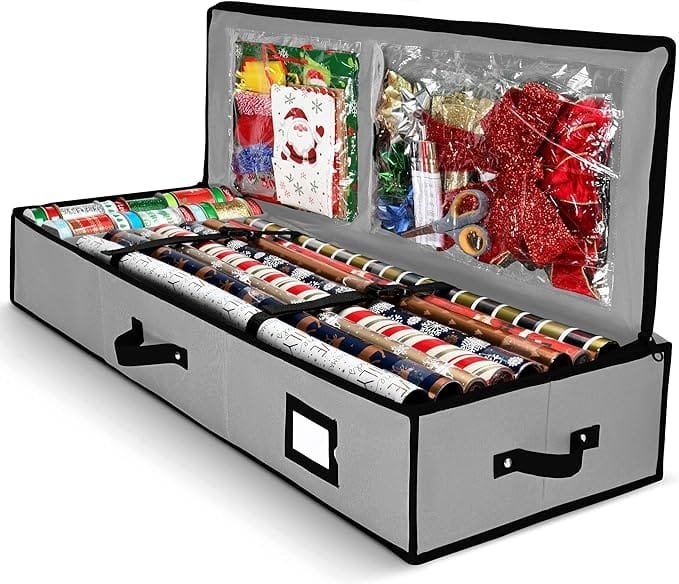
| Flat under-bed case | Rolls laid flat in rows; bows and tape in clear pockets | 40.5 x 14.6 in fabric case with dual zipper and two clear vinyl pockets (produced reference) | Under beds, shelf tops, shallow closets |
| Upright bin | Any roll shorter than the bin interior height, standing | Interior height must exceed roll length: 30 in standard rolls, 63 in for long rolls | Corners of a closet or spare room |
| Tube with end caps | One roll, individually protected | Interior diameter above roll diameter by about an inch; the roll should not rattle | Expensive or wide-format rolls |
| Caddy with sections | Rolls plus scissors, tape and ribbon in one carrier | Section width against roll diameter | A wrapping station that moves room to room |
The hanging organizer hangs on a door hook or closet rod and keeps every roll visible along its edge. The flat case slides under a bed and closes with a full zipper against dust. The upright bin is the cheapest way to store a lot of rolls when floor or shelf space exists. Tubes cost more per roll and protect the best, which pays off on rolls worth protecting. The caddy matters most to anyone who wraps in a different room each year.
How to choose by your space
One closet, no floor: the hanging organizer on the inside of the door or on the closet rod. Under-bed space open, closet full: the flat case, with rolls laid in the direction the case opens. A garage or basement shelf works only if the space stays dry year-round; if it does not, keep the paper inside the conditioned part of the house and use that shelf for plastic bins instead. A dedicated craft or gift room supports a full wrapping station: an upright bin or caddy for rolls, a drawer or pocket set for ribbons and tags, and the wrapping surface itself.
How to prep rolls before storage
- Use rolls oldest first; newer ones can wait another season rolled as sold.
- Put a cardboard insert in each end of partially used rolls so the wound edge stays supported.
- Wind wide or delicate rolls with a sheet of tissue before they go into a tube or slot.
- Keep rolls away from the water heater, the dryer vent and any window with direct sun.
- Store ribbons wound on their original spools, flat, not folded into pockets.
- Label the storage container by season so December shopping stops at what you already own.
If you buy or resell organizers: what to confirm at the spec stage
Most gift wrap storage on the market is built to a price. A reseller or importer choosing the SKU for a holiday line controls more of the outcome at the spec stage than at the negotiation stage:
- Roll slot count and spacing, checked against the roll lengths your market actually sells, not a generic sample roll.
- Accessory pocket count and placement, matched to the range: bows, labels, tape, scissors.
- Hanging hardware positions, checked against the door thickness of the target market.
- Fabric and coating: coated Oxford fabrics resist moisture; a waterproof PE body suits humid climates.
- Retail packaging: CPP bags, printed inserts, hang tags or retail color boxes, confirmed with the folded size.
Holiday storage programs typically start at 500 pieces per style, with colors mixed within the style. The configurations we build, including the hanging and flat formats above, are listed on the gift wrap storage page with sampling terms.
Frequently asked questions
How should wrapping paper be stored to avoid damage?
Store rolls upright so edges do not press against the container floor, keep them away from humid garage and attic conditions, and use a container with a window or open top so rolls can be found without unrolling.
What sizes of wrapping paper rolls do organizers fit?
Standard gift wrap rolls run about 30 inches long. Produced references in holiday storage lines cover roll lengths up to 63 inches in hanging organizers and 40.5 inches in flat cases; other lengths are quoted per brief.
Can organizers hold accessories as well as rolls?
Yes. The flat container format includes two clear vinyl pockets sized for bows, labels, tape and scissors. Pocket count and placement can be adjusted to the accessory range.
Are the containers waterproof?
The flat case body uses waterproof polyethylene. Coated Oxford fabrics resist moisture. Confirm the expected storage conditions so seams and closures are reviewed together.