To reduce a trunk organizer’s movement, match its underside to the actual cargo-floor surface, make sure the base sits flat, and use a compatible attachment system where required. Check the floor mat as well as the organizer: a grippy base cannot keep the whole assembly in place if the mat underneath moves.
For automotive brands, retail buyers and Amazon sellers, specifying a “non slip trunk organizer” is only a starting point. The sample review needs to identify the floor, the load and the attachment points that the design is intended to work with. This guide provides that review method; it does not report a road test or certify a restraint system.
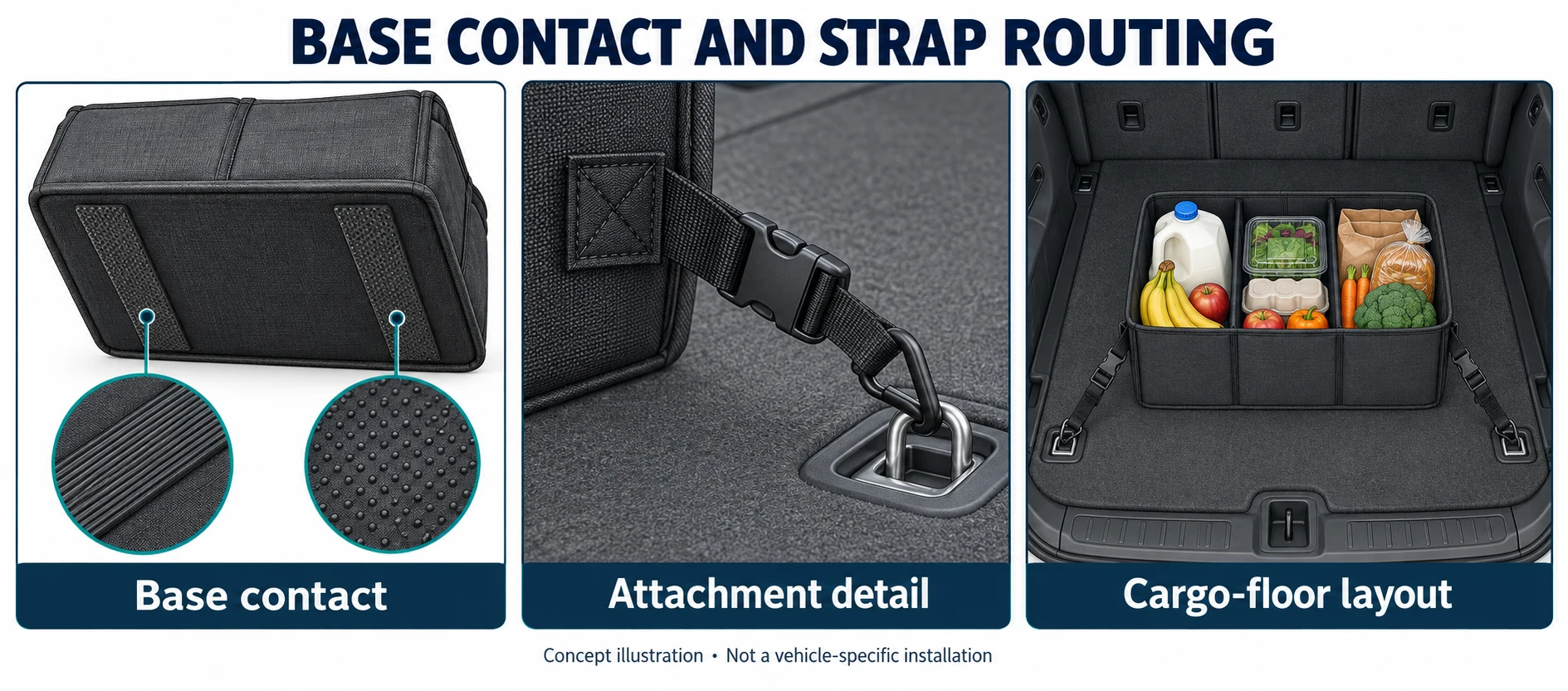
Quick answer: check the surface before choosing the fixing
Start with a photo of the empty cargo floor and the vehicle’s approved cargo attachment points. Measure the intended position, then try the organizer with its base insert fitted and a defined load. Compare base grip and any securing straps as parts of the complete setup.
For a current product example, FORTEM’s Original Trunk Organizer page lists both non-slip strips and adjustable securing straps. Those are useful features to examine separately during buying. Their presence on another product does not establish how a new sample will perform in your target vehicles.
Why does a trunk organizer slide?
Sliding can start at the organizer’s underside, between the mat and vehicle floor, or after the contents shift. Identify which part moved before changing the base material.
The base is not making consistent contact
An uneven insert, a folded corner or a seam sitting proud of the bottom can lift the grip material away from the floor. Ribbed cargo liners may contact only parts of a flat underside.
Open the organizer fully and seat its inserts as instructed. Look underneath and around the perimeter. If it rocks when placed on a flat surface, record that separately from whether the base coating feels tacky to the hand.
The floor surface is different from the sample reference
Carpet pile, a rubberized liner and a smooth plastic tray present different contact surfaces. Even two carpeted trunks may have different pile structures. A surface treatment that works in one setup needs another check when the floor changes.
Record whether the mat is original equipment or an accessory, its visible texture, and its condition. Keep the intended surface clean according to its care instructions before comparison. If contamination is part of the expected use, agree a separate check instead of quietly changing the surface between samples.
The mat moves with the organizer
Check the liner’s own fit and retention. If the organizer stays on the liner but both shift relative to the vehicle, adding more grip to the organizer addresses the wrong interface.
Photograph the position of both objects against fixed reference points while the vehicle is parked. This makes it easier to tell whether you need a different base treatment, a different placement, or a compatible securing arrangement.
The contents make the organizer tilt or distort
A tall bottle on one side and a light bag on the other can produce a different result from a low, evenly distributed load. Flexible walls and unsupported base sections can also change shape when filled.
Define the intended contents and arrange heavier items low, following the vehicle and product instructions. Check both the organizer’s movement and movement inside its compartments. A fixed outer box does not automatically restrain each object inside it.
Compare base strips, grip dots, hook-and-loop and straps
Choose a feature by the surface and attachment conditions it needs. Ask the supplier to identify the actual underside material and construction; names such as “rubber bottom” or “anti-slip fabric” are too broad to settle compatibility.
Non-slip strips
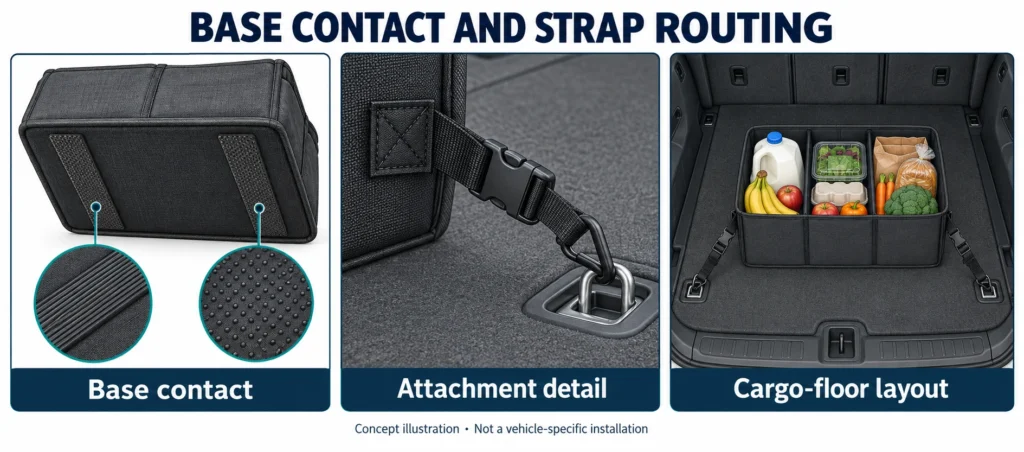
Strips place grip material in selected areas of the base. Review their position with the organizer assembled, including whether the insert keeps those areas flat against the floor. A strip that falls across a recess in a molded liner may have less contact than its visible size suggests.
Ask how the strips attach to the base and inspect their edges after the agreed handling and folding checks. If they are bonded, agree how adhesion will be evaluated. Do not infer service life from the thickness or appearance of a strip.
Dotted grip coatings
A dotted treatment distributes contact points across a backing fabric. Check which points touch the target surface, whether the backing wrinkles, and whether the coating marks the floor material during the agreed contact check.
Dot pattern alone does not identify the coating chemistry or prove a friction level. Confirm the coating specification and test the finished underside against the actual mat, including the intended cleaning method where relevant.
Hook-and-loop contact
Hook material requires a compatible loop surface or another specifically verified mating surface. Some automotive carpeting may engage with hooks; other carpeting may not, and repeated removal may disturb the pile. Test a representative surface and inspect it after removal.
Do not assume that hook tape grips a smooth plastic or rubberized liner. If the design uses a separate mating patch, confirm how that patch attaches, whether it is removable, and whether the vehicle owner permits it. Keep unapproved adhesive modifications out of the standard installation instructions.
Securing straps
Trunk organizer straps connect the product to compatible vehicle attachment points. Review the full connection: the organizer’s reinforced attachment, webbing, adjuster, hook and vehicle anchor. A metal hook alone tells you little about the complete assembly.
Check the adjustment range in the intended position. A strap can be long enough to reach an anchor yet unable to remove slack. Its direction also matters: a route that limits movement one way may leave another direction largely uncontrolled.
Use the vehicle manual to identify permitted cargo anchors. Do not substitute an unverified trim hook, seat mechanism or child-seat anchor, and do not use the carrying handle as a strap attachment unless the product design explicitly supports it.
Vehicle conditions and sample checks
Use this table to select what to examine. These are inspection priorities, not guaranteed matches or test results.
| Vehicle condition | Structure to review | Sample check |
|---|---|---|
| Carpeted cargo floor | Grip strips, dotted coating or verified hook contact | Check contact with the actual pile; inspect both surfaces after removal. |
| Smooth molded liner | Base treatment plus compatible straps where required | Look for rocking on ribs, limited contact and marking; check whether the liner itself moves. |
| Removable or loose mat | Mat retention and permitted vehicle anchors | Record movement of the mat relative to the floor separately from movement of the organizer. |
| Narrow position between wheel arches | Finished footprint, base insert and strap route | Confirm the organizer sits flat without walls being squeezed or straps crossing an obstruction. |
| Cargo anchors near the chosen position | Reinforced attachments, hook geometry and adjuster range | Check that connections seat correctly, slack can be adjusted and required access stays clear. |
| No compatible anchors identified | Vehicle instructions and limits of the proposed base | Do not improvise attachments. Record the intended-use limitation before approving the configuration. |
| Several vehicle models in one retail program | Representative floor and anchor combinations | Keep a separate fit record for each checked configuration; identify untested combinations. |
Separate reduced sliding from cargo restraint
A base treatment may reduce ordinary sliding in a defined setup. That does not establish restraint during sudden braking, a collision or other conditions outside the evaluation. Securing straps also need evidence appropriate to the claim; attaching a strap does not itself establish a restraint rating.
Follow the manual for the actual vehicle and its loading arrangements. For example, Volvo’s guidance on securing loads describes using the vehicle’s load-securing equipment. The approved points and limits for one model should not be transferred to another.
A parked fit review can reveal slack, poor contact and interference. It cannot verify behavior during driving. If a buying program requires dynamic performance evidence, agree the load, setup, method and acceptance limits with qualified testing personnel. Do not use improvised braking or cornering on public roads as the sample approval method.
What to record when checking the sample
Keep enough information for the supplier to reproduce the setup. “It slipped in our SUV” leaves the surface, load and attachment conditions unknown.
Record:
- Vehicle make, model, model year, relevant trim and seat position.
- Floor or liner type, texture, condition and whether it is removable.
- Organizer reference, sample revision, finished dimensions and installed inserts.
- Placement, available floor area, access clearances and photos of the empty location.
- Contents, total loaded weight and where each item sits.
- Base material, contact areas and any places lifted clear of the floor.
- Permitted anchor locations, attachment hardware, strap route and remaining slack.
- Observations, agreed acceptance conditions, photos and the decision to approve or revise.
Check the intended collapsed or divided configurations separately if they will be sold as usable options. Changing the occupied footprint can change the strap path and base contact. Also confirm that the installed organizer does not prevent access to equipment or compartments that the vehicle instructions require users to reach.
During a parked screening check, any movement observed by gentle handling should be described as an observation with the method recorded. Do not convert a subjective hand check into a measured holding force. If force or displacement becomes an acceptance criterion, specify how it will be measured.
After a revision, repeat the affected setup with the same contents and floor. Keep the previous result alongside the new one so a material change is not confused with a different loading arrangement.
Send a configuration brief with the inquiry
Provide vehicle and floor photos, usable dimensions, intended contents, and the location of permitted cargo anchors. State whether the organizer must lift out, fold to a smaller footprint or remain installed when the seats change position.
Great Shine’s custom car trunk organizer options include base-grip and securing details to discuss during configuration. Use the vehicle record above to agree which construction should be sampled and what the sample needs to demonstrate.
Frequently asked questions
Does a non-slip base work on every trunk mat?
No single base description confirms compatibility with every mat. Surface texture, base contact and the mat’s own retention affect the setup. Check the finished product on each surface included in the intended compatibility claim.
Can I add a separate non-slip mat under the organizer?
A separate mat adds another contact interface. Check its size, care requirements, compatibility with the cargo surface and whether it shifts or wrinkles. It does not replace any load-securing measures required by the vehicle manual.
Are straps unnecessary when the organizer sits tightly between the wheel arches?
A close fit may limit movement in some directions, but it does not establish restraint in every direction. Review the vehicle’s loading guidance, the complete load and the permitted attachment method. Do not use a squeezed fit as evidence of restraint performance.
What should a retail listing say about grip?
Describe the actual base treatment and intended compatible surface. Support any performance claim with the recorded method and configuration. Avoid “never moves” or “fits every vehicle” when only specific setups have been evaluated.