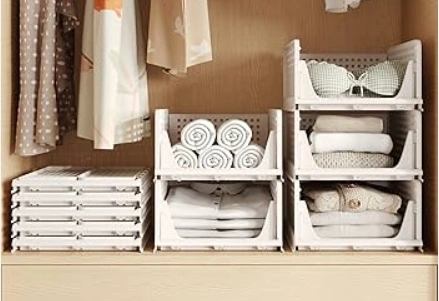
Dividers are the difference between a drawer that stays organized and one that survives until the third rummage. The idea is cheap and universal; the failures are specific: dividers that slide under load, slots sized wrong for the clothes in them, and materials that deform within a season. This guide compares the divider types, gives the sizing rules for the three standard clothing drawers, and covers the setups worth copying before you buy or build a program around them.
The four divider types
| Type | How it works | Best for | Fails when |
|---|---|---|---|
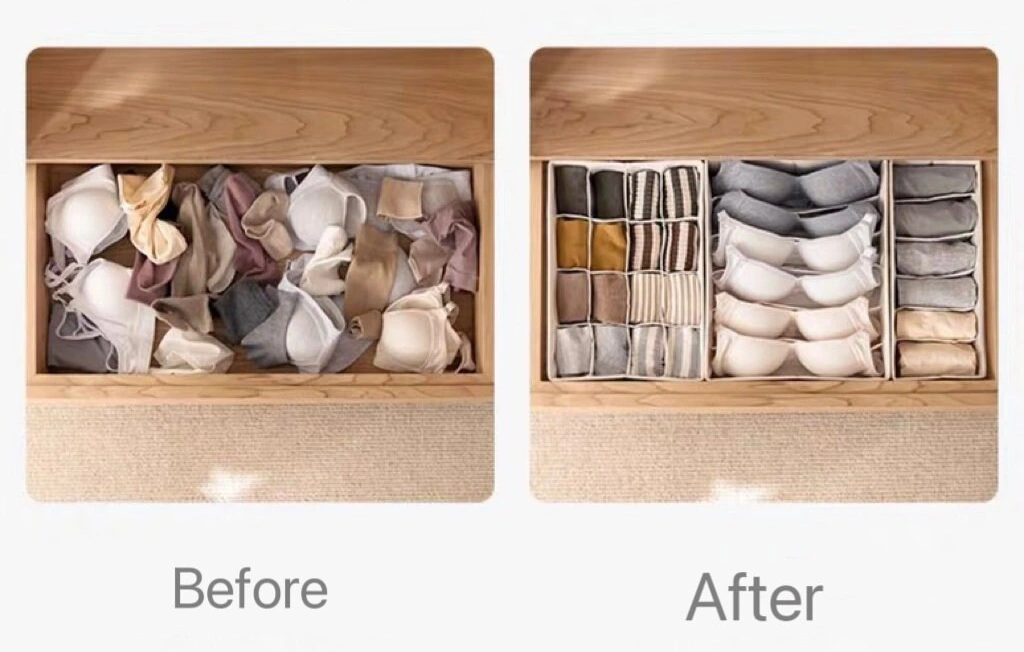
| Adjustable cross dividers | Slotted strips cross to form a grid, cut to drawer length | Sock and underwear drawers | Thin plastic slots crack; grid shifts under heavy rummaging |
| Fabric organizer boxes | Sewn fabric bins with rigid inserts, set side by side | T-shirt and jeans drawers, delicate items | Cardboard inserts bow in humid rooms; cheap lining pills |
| Acrylic or PP bins | Rigid boxes, often modular | Visible drawer-front storage, shared bathrooms | Wrong depth wastes the drawer; rigid edges catch fabric |
| Spring or tension dividers | Fits to drawer width with a spring mechanism | Quick retrofits, rental kitchens | Spring tension drops in wide drawers; they migrate |
Most homes run a hybrid: a cross-grid in the sock drawer, fabric boxes in the shirt drawer. Programs and retailers do the same, selling divider sets that mix two types, because no single type covers all three drawers well.
Sizing rules for the three standard drawers
Clothing drawers come in three depths of content, and the divider sizing follows the fold, not the drawer:
- Socks and underwear drawer: slots 4 to 5 in wide, the width of a rolled pair of socks. Rolling beats pairing for space, and narrow slots hold the roll shape. Deeper slots than that and rolls lean, collapse, and the grid’s purpose is gone.
- T-shirt drawer: bins 9 to 12 in wide, sized so one folded shirt or one file-folded row fits per compartment. File folding, shirts standing on edge, turns the whole drawer into a visible index; the bin width is what keeps the row standing.
- Jeans and pants drawer: one or two full-width sections rather than a grid, because folded jeans are wide and stiff and fight small compartments. If the drawer is deep, a single shallow tray for belts and accessories sits above the stack.
Measure the drawer interior, not the drawer front, and write down the interior height too. Dividers taller than the drawer cavity block it from closing; shorter than half the folded height, and clothes migrate over the walls.
Material checks
- Insert rigidity: press the center of a fabric divider box with a palm. The insert holds or it does not, and no lining fixes a bowed board. PP board and MDF hold; uncoated cardboard does not, especially in humid rooms.
- Grid lock: for cross dividers, assemble the grid and push one corner sideways. Locked slots stay; loose slots telescope, and the grid loses its shape one rummage at a time.
- Edge treatment: run a hand along the top edge. Acrylic bins should be polished; fabric boxes should have a finished binding, because a raw fabric edge frays into the clothes it is organizing.
- Bottom grip: dividers on smooth drawer bottoms slide. Look for a textured base or accept that every setup needs a grip mat, a detail that retail programs often bundle in.
Setups worth copying
The reference layouts that keep working: a 4×6 adjustable grid in the sock drawer with one corner cell left empty as a “odd sock” tray; three fabric bins across the shirt drawer, categories split by activity not by color, because morning decisions are about activity; and a single full-width jeans section with a shallow accessory tray. For deep drawers, a two-layer system with a slide-out tray on top multiplies usable space without excavation. Deep-drawer organization is its own topic, and our deep drawer guide covers it in full.
For retail and sourcing programs
Divider sets are a standard fabric-goods program: non-woven or canvas shells, PP-board inserts, flat-pack shipping, and a print area on the front of each bin. The spec decisions that decide both cost and return rate are insert board thickness, binding tape quality, and whether the set fits standard drawer interiors, which vary less than people think: most clothing drawers run 20 to 30 in wide. Selling a set that fits the range, rather than one exact drawer, is the difference between a program and a custom job.
FAQ
What size dividers for a sock drawer?
Slots 4 to 5 inches wide, sized to a rolled sock pair. Match the grid to your drawer interior length with cut-to-size strips, and leave one cell empty as an odd-sock tray.
Do adjustable dividers actually stay in place?
The slotted-grid type stays if the slots lock, which the corner-push test checks in one second. Spring-tension dividers wander in drawers wider than about 18 inches.
Are fabric or acrylic dividers better?
Fabric with rigid inserts for clothing drawers, softer edges and quieter daily use. Acrylic for display-facing drawers and bathrooms, where visibility and cleaning matter more.
How do you keep dividers from sliding?
Textured base or a grip mat under the grid. Smooth drawer bottoms plus lightweight dividers equals drift; the fix costs almost nothing and retail sets increasingly bundle it.
Can dividers work in deep drawers?
Yes, with a two-layer setup: standard dividers at the bottom for folded items, a shallow slide-out tray on top for accessories. Deep drawers fail when everything is one layer.