Custom utility tote bags are used across retail, promotions, gifting, ecommerce, and seasonal campaigns. Because the category looks simple, many buyers underestimate the details that affect final quality, margin, and reorder stability.
In practice, utility tote bag projects are often won or lost by specification control. Two bags may look similar in a quote sheet, but the finished products can perform very differently depending on fabric weight, handle construction, logo method, and packaging decisions.
At Great Shine, we work with custom storage and travel product buyers who need OEM and ODM support, including tote bags, packing cubes, garment bags, and organization products. This guide explains what wholesale buyers should check before ordering custom utility tote bags with logo.
Why Utility Tote Bags Are a Strong Wholesale Category
Utility tote bags are flexible products because they can be positioned for different markets:
- retail and ecommerce
- grocery and daily-use collections
- corporate gifting
- promotional campaigns
- event giveaways
- seasonal product bundles
For buyers, this flexibility creates two advantages:
- the product can be adapted for multiple customer groups
- branding can be applied clearly through logo, color, and packaging
That makes utility tote bags suitable for both long-term product lines and short-cycle promotional projects.
1. Define the Market Position Before Sampling
Before approving a sample or comparing quotations, buyers should define the intended market position.
The same product category can serve:
- low-cost promotional programs
- everyday retail lines
- stronger reusable shopping lines
- premium private label collections
Without this positioning step, buyers often request samples that are either too expensive for their target market or too weak for the customer expectations of that market.
Start with these questions:
- Is the bag for promotion, retail, or long-term brand use?
- Will customers use it occasionally or frequently?
- Should the bag feel lightweight or more structured?
- Does the design need a premium appearance?
- Will the product be sold online, in store, or through distributors?
These answers help determine material, stitching standard, logo method, and packaging plan.
2. Material Selection Is More Than a Cost Decision
Material changes the appearance, feel, durability, and pricing of the tote bag.
Common material options include:
Non-Woven Fabric
This is often used for promotional and cost-sensitive projects. It can work well when the buyer needs lightweight bags at a lower cost, but it is not always suitable for a premium retail positioning.
Best for:
- promotional programs
- trade shows
- lower-cost campaign bags
Cotton Canvas
Canvas is commonly used for retail and brand-focused projects because it looks more substantial and supports a stronger reusable image.
Best for:
- lifestyle retail
- private label collections
- branded gift programs
Oxford Fabric or Polyester
These materials are often selected when buyers need a cleaner structure, higher durability, or easier maintenance.
Best for:
- utility use
- daily carrying
- structured branded tote projects
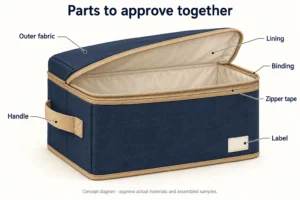
Buyers should confirm:
- material weight
- thickness
- whether lining is included
- whether bottom reinforcement is used
- whether the bag needs water resistance
3. Handle Construction Affects Real-World Performance
One of the most overlooked issues in tote bag sourcing is handle quality.
Even if the bag body looks acceptable, weak handles can quickly create product failure. Buyers should check:
- handle width
- handle length
- stitching method
- reinforcement at attachment points
- cross-stitch or box-stitch support
If the bag is intended for shopping, gifting, or daily use, handle strength should be tested under realistic load conditions.
4. Logo Method Should Match the Product and Market
Logo application is not just a branding decision. It also affects cost, appearance, and MOQ.
Common logo options include:
- silk screen printing
- heat transfer
- embroidery
- woven label
- patch application
For buyers, the best choice depends on:
- material type
- target price range
- brand style
- expected order quantity
- packaging format
For example, a promotional bag may work well with simple screen printing, while a stronger retail product may benefit from woven labels or embroidery depending on the look the brand wants to present.
5. Size and Structure Should Be Matched to Use Case
Custom tote bags can be produced in many sizes, but the right size depends on the product’s end use.
A buyer should decide whether the bag is intended for:
- grocery carrying
- retail shopping
- event distribution
- document carrying
- travel utility
- brand gift packaging
Important details include:
- open top or zipper closure
- gusset depth
- flat or structured bottom
- inside pocket or no pocket
- shoulder carry or hand carry
Clear decisions here help reduce unnecessary sample revisions.
6. MOQ and Packaging Should Be Quoted Together
MOQ is often discussed too early and too narrowly.
In custom utility tote bag projects, MOQ depends on:
- fabric choice
- color customization
- printing method
- packaging style
- labeling requirements
- construction details
If the buyer wants a simple standard item, MOQ may be more flexible. If the buyer needs:
- branded insert card
- barcode sticker
- custom color matching
- premium logo application
- individual retail packaging
then MOQ and lead time may change accordingly.
That is why serious buyers should request quotations based on the full project specification rather than asking for price alone.
7. Packaging Matters for Wholesale Margin
Packaging is especially important when bags are sold through retail or ecommerce channels.
Before production, buyers should confirm:
- individual bag packing
- folded or flat packing
- insert cards
- barcode labels
- carton mark format
- carton quantity
- shipping efficiency
For ecommerce channels, good packaging helps with:
- warehouse processing
- label accuracy
- reduced shipping volume
- cleaner customer presentation
8. Samples Should Be Evaluated Like a Buyer, Not Just a Designer
A sample can look attractive in photos while still failing in commercial use.
Buyers should review:
- actual dimensions
- fabric hand feel
- handle strength
- sewing quality
- printing quality
- reinforcement details
- packaging accuracy
If the order is for repeated sales, sample approval should focus on consistency and reusability, not only appearance.
9. Lead Time and Reorder Stability Are Key Supplier Signals
Many suppliers can ship the first order. The bigger question is whether they can support repeated bulk production without unstable quality or delivery delays.
Ask the supplier:
- What is the standard sample lead time?
- What is the bulk production lead time?
- Can repeat orders use the same material source?
- How do they control color consistency?
- Can they support urgent production windows?
This matters especially for seasonal campaigns and ongoing retail programs.
10. What to Send When Requesting a Utility Tote Bag Quote
To get a more accurate quotation, buyers should send:
- target market
- bag size
- material preference
- color requirement
- logo method
- packaging requirement
- quantity
- delivery expectation
The better the brief, the better the quote and the fewer delays in sampling.
Recommended Product Options
If you are sourcing tote and travel bag products, you may also review:
- Wholesale Custom Utility Tote Bags With Logo
- How to Choose a Custom Utility Tote Bag Manufacturer
- Custom Travel Bags With Logo Manufacturer
FAQ
What material is best for custom utility tote bags?
It depends on product positioning. Non-woven fabric is often used for promotional orders, while canvas and stronger structured fabrics are more suitable for retail and private label products.
Can I customize the bag with my logo and packaging?
Yes. Buyers can usually customize logo application, labels, insert cards, outer carton marks, and other packaging details depending on the project.
What affects MOQ the most?
MOQ is usually affected by material, color, printing method, packaging, and overall construction complexity.
Why do two tote bag quotes vary so much?
Because material weight, stitching standard, handle reinforcement, logo method, and packaging can all change the real manufacturing cost.
Final Thoughts
A custom utility tote bag project should not be judged by unit price alone. The better supplier is the one who can match your target market, control quality consistently, support branding needs, and keep bulk production stable.
If you are sourcing custom utility tote bags with logo for retail, ecommerce, gifting, or promotional programs, Great Shine can support OEM and ODM development with material selection, sampling, packaging customization, and wholesale production.
Contact us for quotation support, sample details, and customization discussion.