Ordering custom fabric storage bins from China can be a strong option for retailers, importers, private label brands, and home organization distributors that need flexible product design, wholesale pricing structures, and OEM/ODM customization. The key is not simply finding a supplier. The key is asking the right questions before sampling and before confirming a bulk order.
Fabric storage bins look simple on a retail shelf, but small sourcing decisions affect cost, carton efficiency, shelf presentation, durability, packaging, and customer returns. Material weight, board thickness, handle structure, stitching method, logo placement, folding design, and packaging format can all change the final product.
This guide gives sourcing managers a practical RFQ checklist for evaluating a fabric storage bins manufacturer or supplier in China. Use it before requesting a quote, comparing samples, or preparing a private label storage program.
1. Start with the Retail Use Case, Not Only the Product Name
Before asking for a price, define how the storage bin will be sold and used. A collapsible fabric bin for closet shelves is different from a lidded storage box for bedding, a drawer organizer, a toy storage bin, or a decorative basket for open shelving.
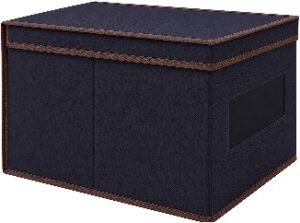
A clear use case helps the supplier recommend the right structure. For example, a lightweight foldable bin may work for seasonal apparel storage, while a box with a lid may need stronger side panels, a more stable base, and a cleaner retail appearance. Buyers comparing related products can review examples such as Chinese fabric storage boxes with lid to think through lid, handle, folding, and display requirements.
Useful buyer questions include:
- Will the product be used in closets, bedrooms, living rooms, kids rooms, dorms, or retail gift sections?
- Should the bin be foldable for lower shipping volume?
- Does the target customer need a lid, clear window, label holder, reinforced handle, or divider?
- Will the item be sold as a single unit, set, bundle, or part of a wider home organization range?
- What price tier and shelf positioning does the retailer need to hit?
These answers help the manufacturer quote a product that fits the retail program instead of quoting a generic bin that may not match the market.
2. Confirm Size, Shape, and Folding Structure Early
Custom size is one of the first specifications to confirm because it affects fabric consumption, board size, packing method, carton quantity, and shelf fit. Retail buyers should provide dimensions in a clear format, including length, width, height, and tolerance expectations if known.
For US and European markets, buyers may prioritize closet shelf compatibility, cube organizer fit, bedding storage, or multi-pack value. For Japanese and South Korean markets, compact dimensions, clean folding design, and efficient storage may be especially important. The best size is not always the largest size. It is the size that matches the customer use case, packaging plan, and retail price point.
Ask the supplier:
- What size options are already developed and suitable for faster sampling?
- Can the bin be folded flat for shipping and retail packaging?
- Which dimensions change material usage most significantly?
- Will the side walls hold shape after repeated folding and unfolding?
- Can the supplier provide a drawing or sample confirmation before bulk production?
If your brand already has a target retail shelf size or carton requirement, include that in the RFQ. A manufacturer can often suggest structure adjustments before sample development.
3. Compare Fabric, Board, Lining, and Handle Options
Fabric storage bins can be made with different outer fabrics, linings, stiffening boards, and handles. Each choice creates a tradeoff between cost, appearance, strength, weight, and customer perception.
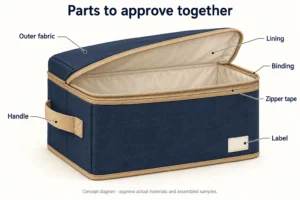
Common RFQ details include outer fabric type, fabric color, lining material, board insert, handle design, stitching color, edge binding, label position, and whether the product needs a lid or clear window. Do not assume two suppliers are quoting the same construction unless the material and structure are defined.
| Specification Area | Lower-Cost Direction | Stronger Retail Direction | Buyer Question to Ask |
|---|---|---|---|
| Outer fabric | Basic non-woven or simple polyester | Heavier fabric, textured fabric, or decorative finish | What material options match our target price and shelf appearance? |
| Side support | Thinner board or lighter structure | Reinforced board or stronger panel design | How will the bin keep shape during normal use? |
| Handle | Simple fabric handle | Reinforced stitched handle or stronger grip design | What load expectation should we confirm during sample review? |
| Lid | No lid or soft cover | Fitted lid with cleaner presentation | Does the product need dust protection or stackable display appeal? |
| Branding | Generic label or no logo | Woven label, printed logo, hangtag, or private label packaging | Which logo method works best for this fabric and order plan? |
| Packing | Simple polybag | Retail-ready insert card, belly band, color box, or set packaging | Which packaging option fits our sales channel and carton target? |
Because proof and testing requirements vary by buyer, ask the supplier what checks can be performed and what documentation can be provided for your target market. Avoid assuming compliance until documentation is reviewed by your team.
4. Ask About OEM, ODM, and Private Label Flexibility
Some buyers already have technical drawings, brand colors, packaging artwork, and a defined retail plan. Others need ODM support, where the supplier helps adapt an existing structure into a market-ready product.
For broader custom bag and storage product programs, Great Shine provides relevant OEM/ODM service pages for buyers reviewing customization scope: Custom Bags Manufacturer for OEM & Private Label and OEM/ODM Private Label Bag Manufacturing.
When discussing private label fabric storage bins, clarify:
- Can the supplier customize size, fabric, color, handle, lid, logo, label, and packaging?
- Does the supplier support both OEM development from buyer specifications and ODM adaptation from existing product styles?
- What artwork files are needed for logo and packaging review?
- Can the supplier provide a pre-production sample for confirmation?
- Which customization points may increase cost, sample time, or production complexity?
A useful supplier will help explain the tradeoffs. For example, a custom print may create stronger branding, while a woven label or hangtag may be more flexible for smaller product families. A color box may improve retail shelf appeal, while compact folded packaging may improve shipping efficiency.
5. Discuss MOQ Without Treating It as Only a Number
MOQ matters, but buyers should not evaluate it as a single isolated figure. MOQ may depend on fabric sourcing, dye color, logo method, packaging material, carton plan, and whether the design is based on an existing style or a new development.
Because exact MOQ can vary by product and customization level, the safest RFQ question is: what MOQ applies to this exact material, size, color, logo method, and packaging option?
Ask these questions before comparing suppliers:
- Is the MOQ different for stock fabric colors versus custom colors?
- Does private label packaging change the MOQ?
- Can sampling be done before bulk MOQ confirmation?
- Are there different MOQ requirements for assorted colors or multi-pack sets?
- What changes would make the project easier to produce at the required order volume?
This approach helps buyers avoid misleading price comparisons. A quote for a standard fabric bin with generic packaging is not equivalent to a quote for a custom-size, private label, lidded storage box with retail packaging.
6. Define Sample Expectations Before Paying for Development
Samples are not only for appearance. They are the buyer’s chance to confirm structure, fabric handfeel, folding recovery, stitching quality, label placement, packaging method, and basic use performance.
Before requesting a sample, provide a clear sample brief:
- Target dimensions and acceptable tolerance if required
- Reference photos or product links
- Fabric preference and color reference
- Logo size, color, and placement
- Packaging concept
- Any retailer-specific requirements that the supplier should know early
When the sample arrives, review it like a sourcing manager, not only like a consumer. Check whether the side panels stand properly, whether the product folds cleanly, whether the handle feels secure, whether the lid fits naturally, whether stitching is straight, and whether packaging protects the shape during transit.
If your company has internal test standards, share them with the supplier. If not, ask what quality checks they normally recommend for this product type and confirm what can be documented before shipment.
7. Make Packaging Part of the Product Decision
Packaging affects retail conversion, freight efficiency, and warehouse handling. A fabric storage bin may be packed flat, folded, nested, bundled as a set, or displayed with a belly band, insert card, hangtag, polybag, or color box.
For e-commerce sellers, packaging may need to protect the product from compression, dust, and deformation. For retail buyers, packaging may need barcode placement, clear product information, shelf-ready presentation, or multilingual labeling. For importers and distributors, carton dimensions and packing quantity may be just as important as the unit package.
Ask the supplier:
- What is the most space-efficient packing method for this structure?
- Can the product be packed as a set without damaging shape or fabric?
- Where should barcode, warning text, recycling marks, or retailer labels be placed?
- Can the supplier follow buyer-provided packaging artwork?
- What packaging options are recommended for retail, e-commerce, or wholesale distribution?
Do not leave packaging until the end. Packaging can change product cost, carton size, and production planning.
8. Build QC Questions Into the RFQ
Quality control should be discussed before order confirmation. For fabric storage bins, buyers often need to control visual appearance, dimensions, stitching, folding function, handle strength, logo accuracy, packaging accuracy, and carton labeling.
Practical QC questions include:
- What inspection points are recommended for fabric storage bins?
- How are dimensions, color, stitching, logo placement, and packaging checked?
- Can a pre-production sample be approved before bulk production?
- Can the supplier provide production photos or inspection records if requested?
- What should the buyer confirm before shipment?
If your market requires specific compliance documents, chemical restrictions, labeling rules, or retailer protocols, treat those as buyer-side confirmation points and discuss them early. A supplier can only quote accurately when requirements are clear.
Buyer Checklist Before Sending an RFQ
Use this checklist before contacting a fabric storage bins supplier in China:
- Product type: open bin, lidded box, drawer bin, shelf cube, toy bin, bedding box, or set
- Target market: United States, Europe, Japan, South Korea, or multi-market program
- Size: length, width, height, folding size if needed, and shelf/carton restrictions
- Material: outer fabric, lining, board support, handle material, and trim details
- Structure: lid, divider, clear window, label holder, reinforced bottom, or collapsible design
- Branding: logo method, woven label, printed mark, hangtag, private label packaging
- Packaging: polybag, insert card, belly band, color box, set pack, carton labeling
- Quantity: estimated order volume and whether assorted colors or sets are needed
- Sample: sample purpose, approval process, artwork files, and required sample details
- QC: inspection points, documentation needs, and retailer-specific requirements
- Quote basis: confirm whether the price is based on the same specification across all suppliers
A complete RFQ saves time for both the buyer and the manufacturer. It also reduces the risk of receiving prices that cannot be compared fairly.
When to Request a Quote from Great Shine
Retail buyers should request a quote when the product concept is specific enough for a supplier to evaluate material, structure, customization, packaging, and order requirements. You do not need every detail finalized, but you should know the intended product type, target market, approximate size, branding needs, and sales channel.
Great Shine Home Storage Supplier works with home storage and bag product categories, including fabric storage boxes, closet organizers, storage bags, packing cubes, garment bags, and related custom programs. Buyers reviewing connected storage formats may also compare products such as a wholesale fabric foldable over-the-door shoe organizer when planning a broader closet organization range.
To start a practical discussion, prepare your target product photos, size requirements, expected order quantity, logo needs, packaging idea, and destination market. Then contact Great Shine through the request a quote page for supplier feedback on material options, customization routes, and RFQ details.
FAQ: Custom Fabric Storage Bins from China
What information should buyers include in an RFQ for custom fabric storage bins?
Include product type, dimensions, material preference, structure, logo method, packaging format, estimated quantity, target market, sample requirements, and any retailer-specific QC or labeling needs. Photos or reference links are also useful.
Can fabric storage bins be customized for private label retail programs?
Yes, many fabric storage bins can be customized with size, fabric, color, logo, labels, hangtags, and packaging. Buyers should confirm which options are available for the exact product structure and order plan.
How should buyers compare quotes from different suppliers?
Compare quotes only when the specification is the same. Material, board thickness, handle design, logo method, packaging, carton quantity, and QC requirements can all change the cost.
What should buyers check in a fabric storage bin sample?
Review size, shape stability, folding function, fabric appearance, stitching, handle strength, lid fit if included, logo accuracy, packaging method, and whether the product matches the intended retail channel.
When should compliance or documentation questions be discussed?
Discuss them before sampling or quotation if the product will be sold through a retailer or market with specific requirements. Ask what documentation can be provided and have your team verify requirements for the destination market.
Record one line for each fabric-bin version
For each version, write the finished external length, width and height; the intended shelf opening; body material; support-panel arrangement; base; lid; handle; label; and folded pack. Ask the supplier to identify any missing field before quoting. Separate a colour change from a pattern or structural change.
Specify the intended contents and retrieval direction, then request a loaded sample to check fit and access. Record which dimensions are external and which describe usable space. Keep the agreed measurement method with the drawing so later samples are compared consistently.