Choosing a custom fabric storage bins manufacturer is not only a question of finding a supplier that can produce a bin in the right color. For retail buyers, importers, wholesalers and private label brands, the better choice is a manufacturer that can translate a product brief into a repeatable commercial item: correct dimensions, suitable material and reinforcement, consistent logo placement, retail-ready packaging and clearly defined quality-control checkpoints.
Before sending an RFQ, buyers should compare suppliers on five practical areas: product construction, customization scope, sampling process, packaging requirements and QC communication. These criteria help reduce costly revisions and make it easier to compare quotations on the same basis. Buyers developing related storage categories can also review Great Shine’s fabric storage boxes with lid and broader OEM/ODM private label manufacturing options as reference points before requesting a quote.
Why Buyers Search for a Custom Fabric Storage Bins Manufacturer
Fabric storage bins are sold across home organization, closet storage, children’s storage, seasonal merchandising and private label household ranges. A buyer may be replacing an existing supplier, extending a successful storage line or developing an exclusive style for a retail program.
In each case, a generic product listing is not enough. The supplier needs to understand how the bin will be used, displayed, packed and evaluated by the buyer’s market. A foldable closet bin for a US retailer may require different packaging and labeling discussions than a compact organizer intended for a Japanese home storage assortment. Buyers in Europe or South Korea may also have their own packaging, documentation and product review requirements to confirm before order approval.
The sourcing objective is therefore clear: identify a supplier that can respond accurately to a detailed RFQ and produce an approved sample that reflects the intended bulk product specification.
Define the Product Specification Before Comparing Suppliers
A manufacturer can only provide a useful proposal when the buyer defines what the product must do. For custom fabric storage bins, the RFQ should begin with the structure and use case rather than only a target appearance.
1. Size, Shape and Storage Application
State the required external dimensions, expected contents and where the bin will be used. A bin intended for a cube shelf needs dimensions aligned with shelf clearance, while a closet organizer bin may prioritize handles, stackability or a fold-flat structure.
Useful specification points include:
- Finished size and acceptable dimensional tolerance to be confirmed with the supplier.
- Open-top, lidded, drawer-style or foldable construction.
- Intended contents, such as garments, toys, bedding accessories or household items.
- Need for handles, label windows, dividers, lids or closure features.
- Shelf, cabinet or retail-display size limitations.
For buyers comparing adjacent organizer designs, a product such as a foldable over-the-door shoe organizer can help illustrate how format and storage application affect construction decisions.
2. Material and Reinforcement Choices
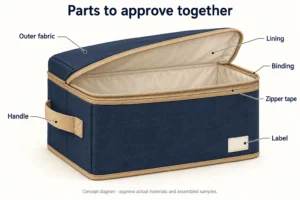
Fabric bins often combine an outer fabric with supporting components that help maintain shape. The exact material specification affects appearance, handling, folding performance, packing volume and positioning within a retail range.
Ask each prospective supplier to identify the proposed material composition and structure for your intended design. Key confirmation points include:
- Outer fabric type, weight or finish suitable for the requested appearance.
- Inner lining or backing, if required for the design.
- Reinforcement method for side panels, base or lid.
- Handle construction and attachment method.
- Whether the product is designed to fold flat for shipping and retail storage.
- Color matching process and how color approval is recorded during sampling.
Do not assume that two visually similar fabric bins use equivalent construction. A lower quotation may reflect a different fabric, lighter reinforcement, simplified stitching or altered packaging. A meaningful comparison requires suppliers to quote against the same specification.
3. Branding and Private Label Details
For a private label program, branding must be defined early because logo application can influence material choice, sample cost discussions, artwork preparation and packaging layout.
Your RFQ should specify whether you require a woven label, printed logo, embroidery, hangtag, insert card, barcode label or retail packaging artwork. Ask the manufacturer which branding methods suit the selected fabric and product structure, then approve the method during sampling before discussing bulk order confirmation.
Buyers sourcing multiple categories under one brand may also review Great Shine’s custom bag manufacturing page when preparing questions about material, logo and packaging requirements.
OEM, ODM or Wholesale: Choose the Right Development Route
Not every buyer needs the same level of customization. Defining the development route at the start helps suppliers respond with relevant options rather than an unclear quotation.
| Sourcing Route | Best Fit for Buyers | What to Specify in the RFQ | Key Point to Confirm |
|---|---|---|---|
| Wholesale existing style | Buyers seeking a faster assortment addition based on an available product format | Preferred size, color, branding and packaging needs | Whether requested changes are available for that style |
| OEM custom specification | Buyers with dimensions, material direction, artwork and packaging requirements | Full spec sheet, artwork, target market and packaging plan | Sample process and how the approved specification transfers to production |
| ODM development support | Buyers with a product concept but needing structure or material recommendations | Use case, target retail positioning, desired features and reference images | Which design elements require approval before quotation or sampling |
| Private label program | Brands building a coordinated branded range | Logo method, label details, packaging artwork, barcode and assortment needs | How branding and packaging approvals will be documented |
A professional supplier should be able to tell you what information is missing from your brief. If a quotation arrives without clarification on material, structure, logo method or packaging, it may not be comparable with other offers.
Questions About MOQ, Samples, Packaging and QC
Commercial buyers often focus on unit price too early. A useful RFQ also asks how the manufacturer handles decisions that affect risk before a bulk order is placed.
MOQ and Order Planning
MOQ may vary according to product size, selected material, custom color, logo process, packaging and whether the design is based on an existing style or developed as a new product. Rather than expecting one standard answer, ask the supplier to confirm the applicable MOQ for your exact specification and whether different customization levels affect it.
For a multi-SKU program, state the number of colors, sizes or packaging variants required. This makes it easier to identify whether the program structure is practical before sampling begins.
Sample Evaluation
A sample is not simply a visual approval. It should help the buyer verify construction, size, material hand feel, folding behavior, logo position and packaging compatibility.
Request a sample review checklist covering:
- Finished dimensions and intended storage fit.
- Fabric color, surface appearance and structure.
- Panel stability, base support and foldability where required.
- Handle placement and attachment appearance.
- Logo size, position and legibility.
- Label, hangtag, insert or packaging placement.
- Carton packing proposal or pack-out details to be confirmed before the bulk order.
If revisions are needed, record the approved changes in a final specification sheet rather than relying on informal messages or photos alone.
Packaging and Retail Requirements
Packaging affects presentation, shipping efficiency and receiving operations. Tell the manufacturer whether the product will be sold folded, bundled, labeled individually or placed in retail-ready packaging. Include barcode, warning label, country-specific language or retailer packaging requirements if applicable to your program, and ask the supplier to confirm how these will be checked before production.
Quality-Control Communication
Buyers should ask how product requirements will be checked, even when a supplier has produced similar organizers before. The useful question is not whether the supplier has quality control in general; it is which inspection points will be used for your approved specification.
Confirm checkpoints for dimensions, material, color reference, logo position, stitching appearance, handle attachment, folding structure, packaging and carton marking. Any testing, compliance documents or market-specific requirements should be discussed and confirmed based on your product and destination market rather than assumed.
Buyer Checklist for Comparing Fabric Storage Bin Suppliers
Use this checklist before selecting a supplier or approving a sample:
- Have we defined the storage application, finished dimensions and required structure?
- Have all suppliers quoted against the same material, reinforcement and handle requirements?
- Have we specified custom size, color, logo, label and packaging requirements clearly?
- Has each supplier confirmed the MOQ applicable to this exact product configuration?
- Do we understand what is included in sampling and what must be approved before bulk production?
- Have we requested confirmation of dimensional, appearance, branding and packaging QC checkpoints?
- Have we identified destination-market documentation or packaging questions that require confirmation?
- Can the supplier support related organizer products if this item grows into a broader range?
- Is the quotation clear enough to compare product construction, packaging and customization on an equivalent basis?
- Have we documented the approved sample and final specification for purchasing records?
A supplier comparison based on these questions is more reliable than choosing from photos or headline pricing alone.
How to Prepare a Better RFQ for Custom Fabric Storage Bins
A concise but complete RFQ helps both buyer and manufacturer move efficiently. Include your company type and destination market, product reference image or drawing, dimensions, preferred material direction, required structure, expected branding method, packaging needs, quantity by SKU and sample requirements. If your team has retailer compliance, labeling or documentation requirements, list them as confirmation points for the supplier.
It is also useful to identify which details are fixed and which are open to manufacturer suggestions. For example, you may require a custom size and private label packaging while remaining open to fabric or reinforcement recommendations that meet the intended appearance and use case. This allows an OEM/ODM supplier to respond with practical alternatives without changing the commercial objective.
When to Request a Quote from Great Shine
Great Shine Home Storage Supplier presents storage products and OEM/ODM private label services for buyers developing custom home organization assortments. A buyer should request a quote when the project has a defined product type, expected quantity, logo requirement, packaging direction and target market, or when guidance is needed to convert a storage bin concept into a sample-ready brief.
Before contacting a manufacturer, gather your product dimensions, reference images, preferred construction, branding files and packaging requirements. You can review a relevant fabric storage box with lid product example and the OEM/ODM private label service overview to organize your questions.
When your specification is ready, contact Great Shine to request a quote and confirm material options, custom size requirements, sample steps, applicable MOQ, packaging details and QC checkpoints for your intended market. A well-prepared RFQ gives both parties a clearer basis for evaluating whether the product is suitable for development and wholesale supply.
Ask for evidence of the proposed production route
Ask which operations the supplier performs and which are outsourced for your specified fabric bin. Request an explanation of how cutting, panel insertion, handle attachment and packing are checked against the approved sample. Compare the answer with the sample construction; a general factory presentation does not establish capability for every structure.
Keep the supplier review separate from the buying specification. Use the RFQ questions for the order brief and the product inspection checklist for material and finished-item checks.