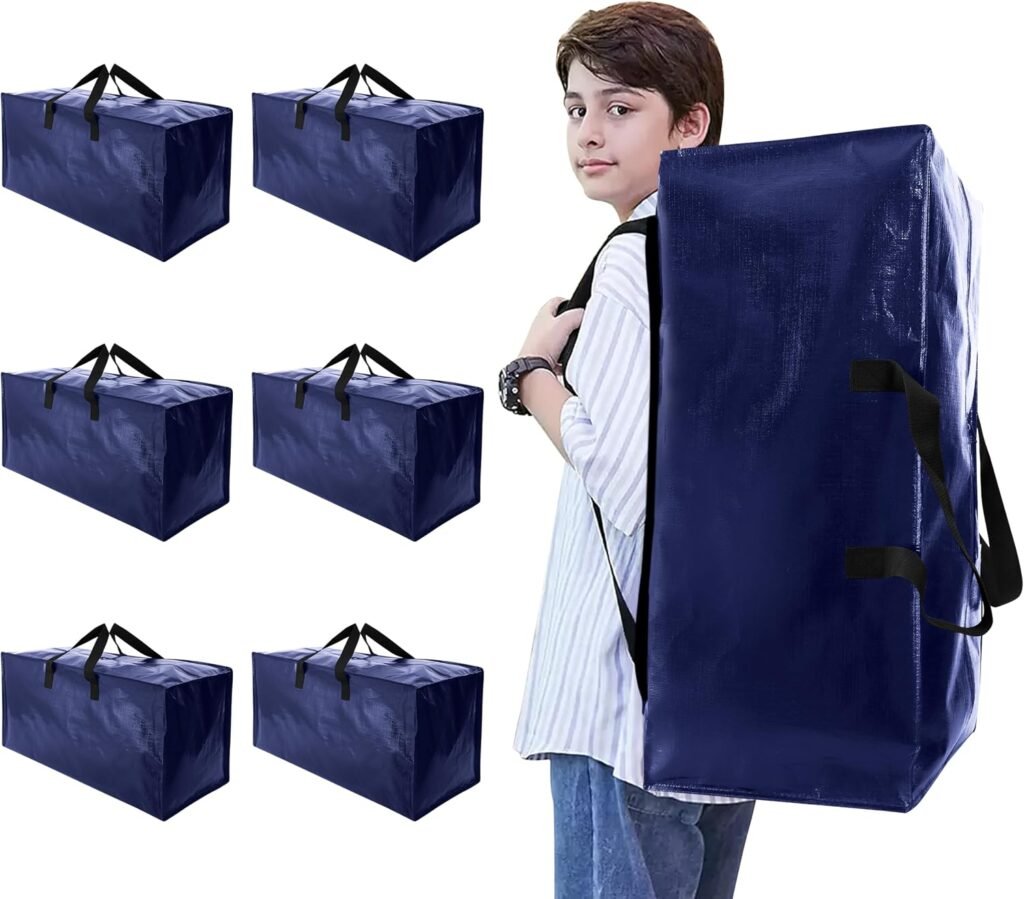
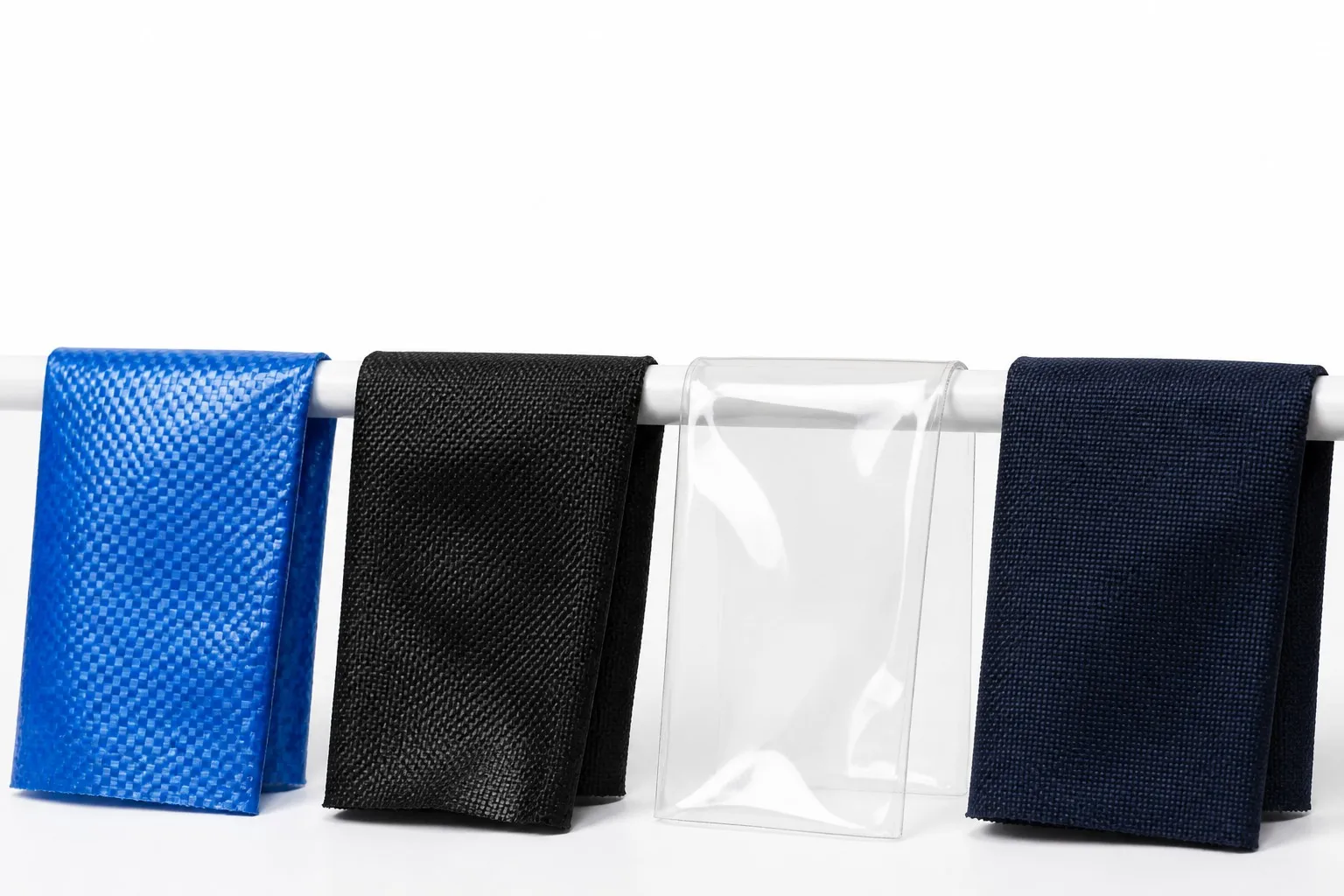
Walk into any Amazon Best Sellers page for moving bags and you will see dozens of listings that look identical — blue rectangular bags with black zippers and handles. But behind the nearly identical photos, these bags are made from completely different materials, with dramatically different load capacities, lifespans, and costs.
As a factory producing over 150 containers of moving bags per year, we manufacture in every common material. This guide explains what each material actually is, how it performs in the real world, and which one fits your product positioning and price point.
The Four Main Moving Bag Materials
Amazon’s Best Sellers are dominated by four materials. Here is what they are, how they are made, and how they perform.
1. PP Woven (Polypropylene Woven, 150-210gsm)
What it is: Polypropylene plastic is melted and extruded into thin flat tapes, which are then woven on a loom into a fabric. The woven fabric is laminated on both sides with a thin PE film for waterproofing.
How it performs:
Amazon Best Seller examples: The #1 Best Seller in moving bags on Amazon is a PP woven 180gsm bag in royal blue. Most top-10 listings use this material because it offers the best cost-to-performance ratio.
Best for: Budget to mid-market positioning. Amazon FBA sellers targeting the $18-25 retail price point for a 6-pack. College dorm moves, seasonal storage, and apartment moves where the bag will be used 3-5 times before disposal.
Watch out for: GSM is everything. A 150gsm bag looks identical to a 210gsm bag in photos, but the 150gsm bag will tear at the handle attachment point after 5-7 uses. The 210gsm bag lasts 15-20 uses. Always specify the GSM in your PO and verify it with a fabric weight scale on the production sample.
2. 600D Oxford (Polyester, PU Coated)
What it is: 600-denier polyester yarn is woven in a basketweave (Oxford) pattern. The fabric is then coated with a layer of polyurethane (PU) on the back side, which makes it water-resistant and adds structure. The front side has a smooth, slightly textured finish.
How it performs:
Amazon Best Seller examples: 600D Oxford bags are positioned as premium on Amazon, retailing at $25-35 for a 4-pack. They are less common in the Best Seller top 10 but dominate the premium and “heavy-duty” search results.
Best for: Premium positioning, DTC brands, retail chain private label. Customers who want a bag that will last for years and double as permanent storage. The PU coating gives the bag structure and a premium hand feel that PP woven cannot match.
Watch out for: PU vs PVC coating. PU (polyurethane) is odor-free, OEKO-TEX certifiable, and does not crack in cold weather. PVC (polyvinyl chloride) is cheaper but has a strong chemical odor, cracks below 0°C, and is restricted under EU REACH regulations. Specify “PU coated, not PVC” in your PO. The cost difference is $0.15-0.25 per bag.
3. PVC Clear (Transparent Polyvinyl Chloride)
What it is: PVC is extruded into a transparent film, typically 0.3-0.5mm thick, and welded at the seams using high-frequency welding. The resulting bag is 100% transparent.
How it performs:
Amazon Best Seller examples: Clear moving bags appear in the top 10 for the search term “clear moving bags.” They serve a specific niche — dormitory compliance (many US colleges require clear bags for security inspections), airport security (TSA-friendly), and retail inventory management.
Best for: Niche compliance markets. College dorm retail programs. Airport/airline promotional products. Not suitable as a general-purpose moving bag — the low load capacity and tear strength make it inferior to PP woven for heavy loads.
Watch out for: PVC is increasingly restricted. EU REACH regulations limit phthalate content in PVC. California Prop 65 requires a warning label for PVC products containing phthalates. If you are selling to the EU or California market, specify “phthalate-free PVC” or consider TPU (thermoplastic polyurethane) as a transparent alternative. TPU costs $0.40-0.60 more per bag but does not yellow, does not crack in cold, and is fully REACH and Prop 65 compliant.
4. 1680D Nylon (Ballistic Nylon)
What it is: 1680-denier nylon yarn is woven in a 2×2 basketweave pattern, creating the densest, most abrasion-resistant fabric used in consumer bags. This is the same material used in high-end luggage, military duffel bags, and tactical gear.
How it performs:
Amazon Best Seller examples: 1680D nylon bags appear in the “rolling moving bags” and “wheeled duffle bags” categories, not in the standard moving bags category. They retail at $30-50+ and target the luggage-adjacent market.
Best for: Rolling moving bags with wheels. Professional moving company fleets. Premium positioning where the bag will be used weekly (not per-move). The material is heavy — a 1680D bag weighs 2-3× more than an equivalent PP woven bag, so it is not suitable for airline weight-restricted travel.
Watch out for: Weight. A 1680D nylon moving bag weighs 600-900g. An equivalent PP woven bag weighs 200-350g. If your customer is flying with the bag, the weight difference matters. For ground transport and storage, weight is less critical.
Material Comparison Matrix
How GSM and Denier Actually Work
Buyers often see numbers like “180gsm” or “600D” on product listings without understanding what they measure. These are not marketing terms — they are technical specifications that directly determine the bag’s performance.
GSM (Grams per Square Meter)
GSM measures the weight of the fabric per square meter. For PP woven and non-woven materials, higher GSM means thicker, stronger fabric.
The jump from 150gsm to 210gsm adds approximately $0.20-0.40 per bag in material cost but doubles the usable lifespan. This is the single most impactful specification for PP woven moving bags.
Denier (D)
Denier measures the weight of the yarn per 9,000 meters. For woven fabrics (Oxford, nylon), higher denier means thicker, stronger yarn.
The jump from 600D to 900D adds approximately $0.50-0.80 per bag but increases tear strength by 40-50%. For bags positioned as “heavy-duty,” 900D is the minimum credible specification.
Handle Construction: The Hidden Failure Point
Material is only half the story. The way handles are attached to the bag determines whether it survives a real move or dumps its contents on a staircase.
Handle Type 1: Stitched-On Handles (Budget)
Two pieces of webbing are stitched onto the exterior of the bag at the top. The stitching bears the entire load.
Failure mode: Stitching tears through the fabric at 10-15kg load. Common on cheap non-woven bags.
Avoid for: Any bag carrying more than 10kg.
Handle Type 2: Wrap-Around Handles (Standard)
One continuous piece of webbing wraps under the bottom of the bag and extends up both sides to form handles. The webbing, not the fabric, bears the load.
Failure mode: Webbing itself may fail at stress points (corners) after 15-25 uses. The fabric does not tear because it is not load-bearing.
Standard for: PP woven bags on Amazon. This is the construction used by the #1 Best Seller.
Handle Type 3: Bar-Tack Reinforced (Premium)
Wrap-around handles with additional bar-tack stitching at every attachment point — top, side, and bottom. The bar-tack distributes stress across a wider area.
Failure mode: Rarely fails. Bar-tack stitching is the strongest stitch pattern for webbing attachment.
Standard for: 600D Oxford and 1680D nylon bags. Specify “bar-tack reinforcement at all stress points” in your PO.
Which Material for Which Amazon Positioning?
Free Material Sample Pack
The only way to truly compare moving bag materials is to feel them in your hands. We ship a free material sample pack containing:
- PP woven 150gsm swatch (budget reference)
- PP woven 210gsm swatch (heavy-duty reference)
- 600D Oxford PU coated swatch (premium reference)
- PVC clear swatch (transparent reference)
- 1680D nylon swatch (tactical reference)
Curated to your product positioning. Shipped worldwide in 3-5 days. Free for OEM buyers with MOQ 500 pcs.
Contact: grace@g-shine07.com WhatsApp: +86 177 0171 9207 Website: greatshine07.com
Great Shine — 16 years manufacturing moving and storage bags. BSCI, ISO 9001, SEDEX certified. 150+ containers per year to 50+ countries.