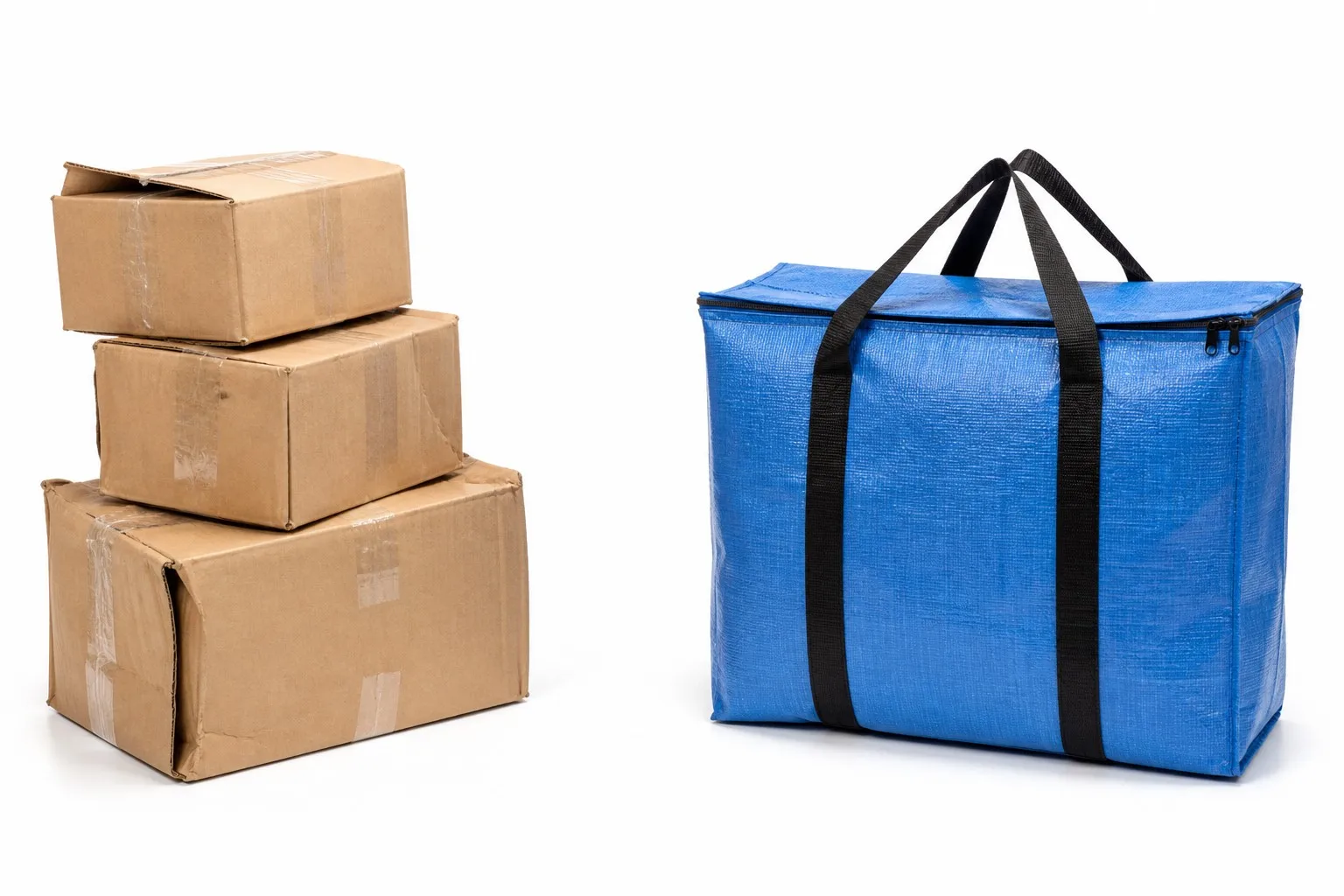
Every year, approximately 40 million Americans move households. The default packing solution for decades has been the cardboard box — cheap, ubiquitous, and seemingly disposable. But in recent years, a new category has disrupted the moving supplies market: heavy-duty moving bags.
Are moving bags actually better than cardboard boxes, or is it just marketing hype? As a factory that has been manufacturing moving bags for 16 years, we have seen both sides of this question from the production floor. This article breaks down the real comparison — cost, durability, convenience, environmental impact, and use-case fit — without the sales pitch.
The Case for Cardboard Boxes
Cardboard boxes are not going away. They have real advantages:
1. Stackability. Cardboard boxes have rigid, flat tops and bottoms. When stacked on a dolly or in a truck, they interlock cleanly. This is the #1 reason professional moving companies still use them — a wall of stacked cardboard boxes won’t shift during transport.
2. Standardized sizes. The moving industry has standardized around specific box sizes — small (16×12×12″), medium (18×18×16″), and large (18×18×24″. These sizes are designed to fit standard moving truck dimensions and dolly widths.
3. Low upfront cost. A standard medium moving box costs 1−2fromHomeDepotorU−Haul.Fora2−bedroomapartmentmoverequiring40−60boxes,thatis40-120.
4. Recyclability. Corrugated cardboard is widely recyclable. Most municipalities accept it curbside. After a move, boxes can be broken down and put in the recycling bin.
The Case for Moving Bags
Moving bags entered the market to solve problems cardboard cannot:
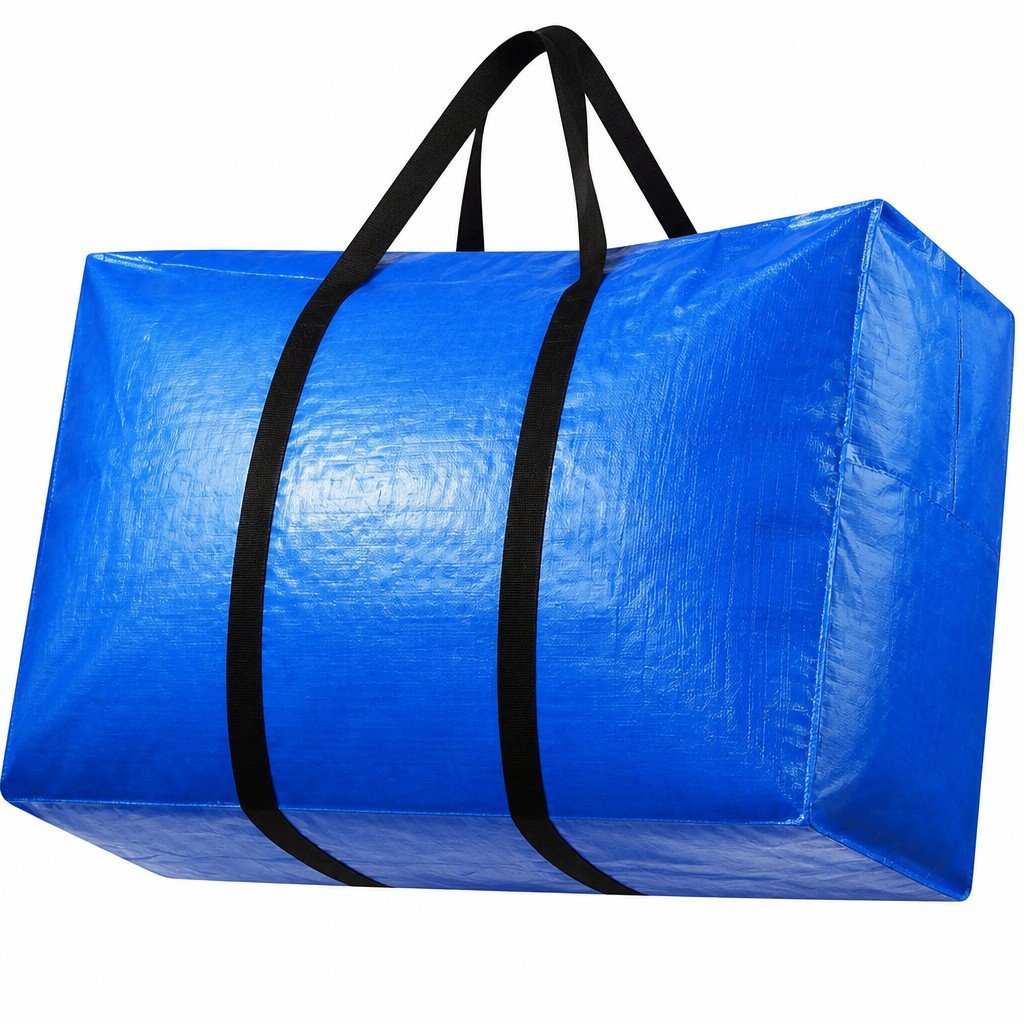
1. Waterproof. Cardboard collapses when wet. If it rains on moving day, cardboard boxes absorb moisture, lose structural integrity, and can dump contents onto the sidewalk. Moving bags — especially PP woven and 600D Oxford — are waterproof. Rain rolls off.
2. No assembly required. Cardboard boxes must be assembled: fold flaps, tape seams, reinforce bottoms. For 50 boxes, that is 1-2 hours of taping before a single item is packed. Moving bags unzip and are ready to load in 5 seconds.
3. Built-in carrying system. Cardard boxes require you to tape a handle or use a box cutter to create hand holes — which weakens the cardboard. Moving bags come with reinforced webbing handles or backpack straps. The backpack strap style is the #1 differentiator on Amazon — it frees both hands for stairs and doorways.
4. Reusability. A cardboard box survives 1-2 moves before the corners split and the bottom gives out. A 600D Oxford moving bag survives 20-50 uses. PP woven bags survive 5-15 uses. The per-use cost of a moving bag is lower than cardboard after the second move.
5. Fold-flat storage. Between uses, moving bags fold to 3cm thickness and slide under a bed or behind a closet. Cardboard boxes, once assembled, take up their full volume even when empty.
Cost Comparison: Real Numbers
Let’s compare the actual cost of moving a 2-bedroom apartment using each method:
The cost advantage of moving bags is clear after the first move. But even on the first move, moving bags are cheaper because you need fewer of them — a single 80L moving bag holds as much as 2-3 medium cardboard boxes.
Durability Test: What Actually Breaks
In our factory testing, here is what fails and when:
The one failure mode unique to moving bags is zipper failure. A cheap local-brand zipper fails after 500-800 open/close cycles. An SBS zipper lasts 1,000-1,500 cycles. A YKK zipper lasts 2,000+. On a moving bag opened and closed 10 times per move, even a cheap zipper lasts 50+ moves.
When to Use Each: Use-Case Guide
Moving bags and cardboard boxes are not either/or. They serve different purposes in a move:
Use Cardboard Boxes For:
- Books and heavy flat objects — books are dense and flat; cardboard boxes stack them efficiently and the rigid walls prevent shifting
- Fragile items — glassware and ceramics need rigid walls for bubble wrap and foam inserts to work properly
- Stacking in a moving truck — rigid boxes create stable walls that don’t shift during transport
- Professional moves — moving companies’ dollies and trucks are sized for standard box dimensions
Use Moving Bags For:
- Clothing and bedding — soft, bulky items that don’t need rigid walls. A single 80L bag holds 4 blankets or 15-20 sweaters
- College dorm moves — students move twice per year; bags are reusable, fold flat under a dorm bed, and backpack straps free hands for carrying other items
- Rainy day moves — waterproof bags protect contents when cardboard would collapse
- Stair-heavy moves — backpack strap bags let you carry a load hands-free up stairs while holding a railing
- Post-move storage — bags that held clothing during the move can stay in a closet as permanent storage. Cardboard boxes look temporary; fabric bags look like storage organizers
The Hybrid Strategy: Best of Both
The smartest movers use both. Here is the optimal split for a typical 2-bedroom apartment:
For this hybrid move, you need approximately:
- 20-25 cardboard boxes ($25-50)
- 8-10 moving bags ($30-45 for a 6-pack + 2 large)
Total: $55-95 — less than all-cardboard, with the bags reused for future moves and storage.
Environmental Impact
The environmental question is more nuanced than “cardboard is recyclable so it’s better.”
Cardard boxes:
- Produced from paper pulp — requires tree harvesting, water-intensive pulping, and chemical processing
- Used 1-2 times, then recycled (but recycling paper also requires energy and water)
- Each move generates 40-60 boxes worth of cardboard waste
Moving bags (PP woven 180gsm):
- Produced from polypropylene — a petroleum-derived plastic
- Used 15-50 times, reducing per-use material consumption dramatically
- At end of life, recyclable as #5 plastic (PP) in many municipalities
- One bag replaces approximately 20-40 cardboard boxes over its lifetime
Moving bags (600D Oxford):
- Produced from polyester — also petroleum-derived
- Used 50+ times
- At end of life, recyclable as polyester fabric in specialized programs
- One bag replaces approximately 50+ cardboard boxes over its lifetime
The environmental math favors moving bags when they are reused. A single PP woven bag used 15 times replaces 15 cardboard box purchases. If it goes to landfill after 15 uses, it still resulted in less total material consumption than the 15 sets of cardboard boxes it replaced.
Why This Matters for Amazon FBA Sellers
If you are sourcing moving bags to sell on Amazon, the comparison above is your market research. Your customer is deciding between your moving bag and a pack of cardboard boxes at the same price point.
Key listing messages that convert:
- “Replaces 3 cardboard boxes each” — a 6-pack replaces 18 boxes. This is the value math.
- “No tape, no assembly, no box cutter” — the convenience angle. Show a 5-second video of unzipping and filling vs. the 2-minute cardboard assembly.
- “Waterproof — rain won’t ruin your move” — the fear angle. Every mover worries about rain.
- “Backpack straps — carry hands-free up stairs” — the differentiation angle. This is what makes your listing photo stand out vs. the flat cardboard box listings.
- “Folds flat to 3cm — store under your bed for next time” — the reusability angle. Cardboard can’t do this.
Sourcing Moving Bags: What to Specify
For Amazon FBA sellers and retail buyers sourcing moving bags from a factory, here are the critical specifications:
Material specification (write this in your PO):
Material: PP woven 180gsm, double-sided PE lamination
Color: Royal blue (Pantone 286 C) or as specified
Size: 27.6" × 13.8" × 16.5" (70×35×42cm) — 24 gallon / 93L
Zipper: #8 nylon coil, SBS brand, double-slider
Handles: Wrap-around webbing, full circumference, X-stitch reinforcement
Label pocket: Clear PVC, 10×6cm, sewn on front panel
Load rating: 50+ lbs static load tested
Packaging: Individual polybag with suffocation warning
FBA labeling: FNSKU barcode on outer polybag
MOQ: 500-1,000 pcs depending on customization level Sampling: 3-7 days, free; courier costs confirmed separately Production lead time: 20-30 days after sample approval
Ready to Source Moving Bags?
We manufacture moving bags in 6 functional styles — backpack strap, clear, heavy-duty, mattress, jumbo, and rolling — in 600D Oxford, PP woven, PVC clear, and 1680D nylon. MOQ from 500 pcs. Free samples with your logo.
Contact: grace@g-shine07.com WhatsApp: +86 177 0171 9207 Website: greatshine07.com
Great Shine — 16 years manufacturing storage and moving bags. 150+ containers per year. 100+ active clients across 50+ countries.