By Grace Ji, Sales Director at Great Shine · Updated August 2026

Most storage bag launches fail on Day 1. Not because the product is bad. Not because the listing is weak. Not because PPC isn’t funded.
They fail because the timeline was wrong.
The factory shipped 12 days late. The container sat at customs for 6 days because a compliance doc was missing. The FNSKU labels were on the wrong side of the carton. By the time inventory hit Amazon’s warehouse, Q4 peak was over and the bestseller window had closed.
I’ve been on the factory side of 3,000+ OEM shipments for 16 years. The difference between a launch that hits its window and one that misses isn’t luck — it’s timeline discipline. Here’s the 90-day framework I give every new buyer, broken down week by week so you can actually plan around it.
The 90-Day Overview
90 days is the realistic minimum. Rushed timelines (45–60 days) exist but require in-stock fabric, no custom dye, and a supplier who prioritizes your order. If you’re targeting Q4 (October–December peak), start by July 1st at the latest.
Phase 1: Specification & Sampling (Days 1–14)
What Happens
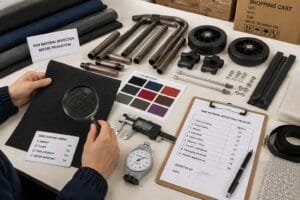
You send your product concept to the factory. The factory reviews feasibility, recommends materials, produces a pre-production sample, and ships it to you.
Week 1 (Days 1–7): Requirements & Fabric
- Day 1–2: Send your design files, reference images, or spec sheet to the supplier. Include: product type, target size, fabric preference, color, logo method, estimated quantity, and target retail price.
- Day 3–5: Factory’s OEM engineer reviews and responds with feasibility feedback, material options, and cost estimate.
- Day 6–7: Confirm fabric selection. If using in-stock fabric, the factory can start cutting immediately. If custom Pantone dye is needed, add 7–10 days to this phase.
Pro tip: Always ask for fabric swatches to be shipped free before committing to a material. Photos don’t show texture, weight, or hand feel. A 0swatchpacketsavesyoufroma4,000 mistake.
Week 2 (Days 8–14): Sample Production
- Day 8–12: Factory’s senior craftsmen produce your sample. Logo, labels, and packaging are simulated on the sample so you can evaluate the complete product.
- Day 13–14: Sample shipped via DHL/FedEx (3–7 days to most destinations).
What to check when the sample arrives:
- Dimensions — within ±0.5cm of spec?
- Color — matches your reference under D65 daylight?
- Stitching — even density, no skipped stitches, reinforced at stress points?
- Zipper — smooth pull, no catching, bar-tack reinforced?
- Handle — comfortable grip, load-tested feel?
- Logo — correct method, correct placement, correct color?
- Odor — no chemical smell? (If yes, your supplier is using PVC coating — switch to PU.)
Phase 2: Sample Approval & PO (Days 15–21)
What Happens
You review the sample, request revisions if needed, approve the final spec, and place your purchase order with deposit.
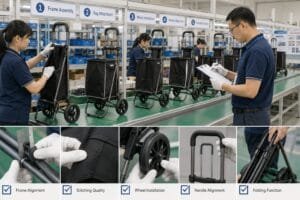
Week 3 (Days 15–21): Approve & Order
- Day 15–16: Review sample. If changes are needed, submit revision requests (fabric weight, color, logo size, compartment layout). Factory re-samples in 5–7 days. Good factories offer free revisions up to 2 rounds.
- Day 17–19: If sample is approved (or after revision is approved), factory issues the final PI (Proforma Invoice) with:
- Unit price (confirmed against your tiered MOQ)
- Total amount
- Lead time breakdown
- Incoterm (FOB/CIF/DDP)
- Payment terms (typically 30% deposit + 70% against BL copy)
- Day 20–21: Pay deposit. Factory locks fabric, assigns production line, and starts material preparation.
Critical: The approved sample becomes your “golden sample.” It should be physically retained by both you and the factory. Every bulk production batch is compared against this sample. No spec changes after this point without written agreement.
Phase 3: Production & QC (Days 22–56)
What Happens
Factory prepares fabric, cuts, sews, assembles, and inspects your order. This is the longest phase and where most delays happen.
Week 4–5 (Days 22–35): Fabric Preparation & Cutting
- In-stock fabric: 7 days to cut and prepare.
- Custom Pantone dye: 10–15 days at the mill, then 2–3 days to cut.
- Factory cuts all fabric panels, prepares webbing, zippers, labels, and packaging materials simultaneously.
Week 6–7 (Days 36–49): Sewing & Assembly
- Production line assigned to your order.
- Sewing, assembly, logo application, label attachment.
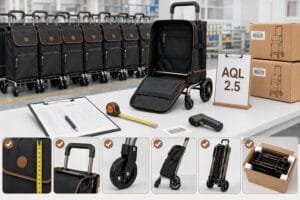
- In-process QC patrol every 2 hours checking stitching density, seam alignment, and dimension tolerance.
Week 8 (Days 50–56): Final Inspection
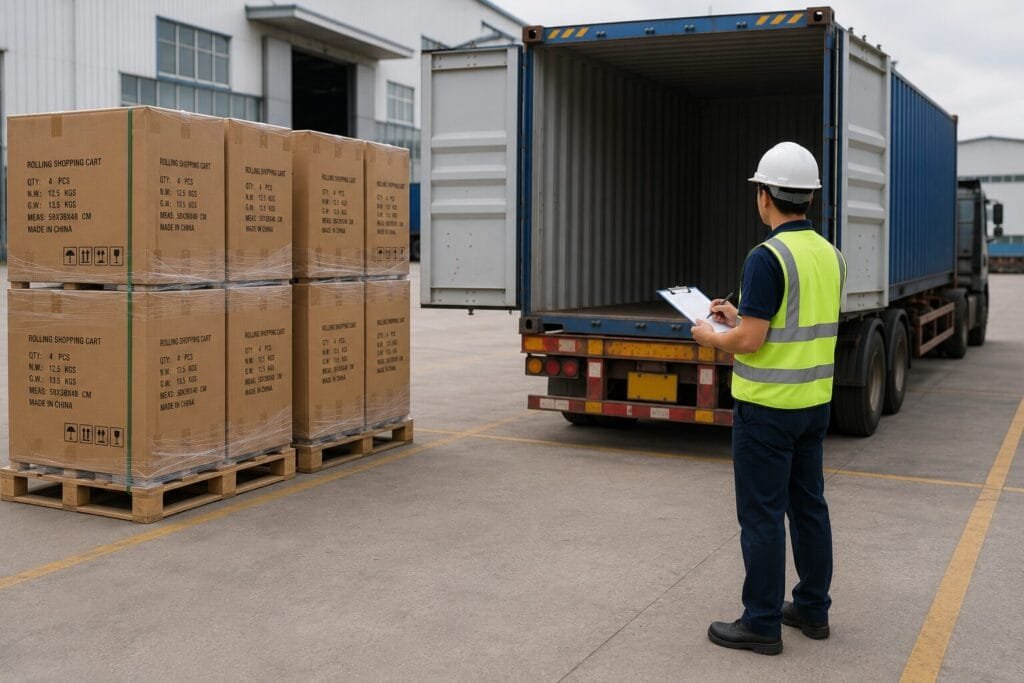
- 4-stage QC process: raw material (done), production patrol (done), final AQL 2.5 inspection per ISO 2859-1, container loading supervision.
- Factory sends pre-shipment inspection photos/video for your approval.
- You approve release or request corrections.
Pro tip: Ask for weekly milestone reports starting from Day 22. A factory that provides weekly updates is a factory that’s tracking your order. Silence = risk.
Phase 4: Packaging & Documentation (Days 57–70)
What Happens
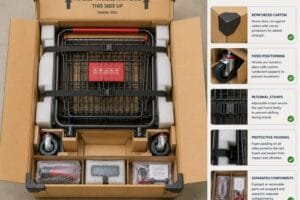
Products are packaged to your sales channel spec, labeled for FBA, and compliance documentation is finalized.
Week 9–10 (Days 57–70): Pack & Label
For Amazon FBA:
- Each unit: FNSKU barcode label, suffocation warning bag (if applicable), Made in China label.
- Outer carton: FBA carton labels, correct dimensions for Amazon size tiers, proper weight.
- All labeling is free with OEM orders at Great Shine.
For Retail:
- Retail-ready packaging: insert cards, hang tags, branded boxes, PDQ display.
- Carton marks: buyer name, PO number, SKU, quantity, gross/net weight, country of origin.
Compliance documentation finalized:
- Commercial invoice with pre-verified HS codes
- Packing list with carton dimensions and weights
- Certificate of Origin (Form E/A/F for FTA duty savings)
- REACH / Prop 65 / CPSIA declarations (if applicable)
- Test reports (fabric composition, harmful substances)
- Fumigation certificate (for bamboo/wood components)
This is where 80% of customs delays originate. A missing REACH declaration can hold your container for 5–7 days. See our landed cost and customs guide for the complete documentation checklist.
Phase 5: Shipping & Customs (Days 71–84)
What Happens
Goods are loaded into a container, shipped by sea freight, cleared through customs, and delivered to your warehouse or Amazon FBA center.
Week 11 (Days 71–77): Container Booking & Loading
- Day 71–73: Factory or freight forwarder books container space with shipping line. Peak season (Aug–Oct) may require 5–10 extra days for booking.
- Day 74–75: Container arrives at factory. Goods loaded, container sealed. Photos of loading sent to you.
- Day 76–77: Bill of Lading issued. You receive shipping documents pack.
Week 12 (Days 78–84): Sea Freight & Customs
- Day 78–82: Sea transit (China to US West Coast: 14–18 days; to EU: 28–35 days; to UK: 30–38 days). Air freight is 3–7 days but 4–5x more expensive.
- Day 83–84: Customs clearance at destination. Broker presents documents, pays duty and VAT on your behalf. Container released for inland transport.
Time-sensitive: Customs clearance takes 1–3 days with complete documentation, 5–10 days with missing or incorrect docs. The difference is entirely in Phase 4.
Phase 6: Amazon Listing & Launch (Days 85–90)
What Happens
Inventory arrives at Amazon FBA warehouse or your own warehouse. Your listing goes live.
Week 13 (Days 85–90): Go Live
- Day 85: Goods received at FBA warehouse. Amazon processes inbound shipment (2–5 days to become “sellable”).
- Day 86–87: Build your Amazon listing using the free assets from your manufacturer:
- Hero image (white background, 2025 Amazon spec)
- Detail images (6–7 shots: features, dimensions, lifestyle, packaging)
- Product video (16:9, 30–60 seconds, with subtitles)
- Backend search terms (40–60 keywords, paste-ready)
- Bullet points (keyword-optimized, benefit-focused)
- Product description / A+ content
- Day 88–89: PPC campaign setup. Start with auto-campaign for data gathering, add manual campaigns for top-converting keywords.
- Day 90: Launch. Monitor BSR, conversion rate, and return rate daily for first 14 days.
Post-launch audit (Day 90 + 30):
- Review mining: read top 20 negative reviews, classify issues
- Return rate check: if above 5%, request engineering analysis from your supplier
- PPC optimization: cut keywords with ACoS above 60%, scale keywords below 30%
The Timeline Killers
Killer 1: Custom Pantone Dye Adds 10 Days
If your fabric color isn’t in the factory’s stock library, the mill needs 7–10 days to dye it. This pushes your entire timeline back by 2 weeks. Solution: choose from 200+ in-stock fabric colors to stay on the 90-day path.
Killer 2: Sample Revision Rounds
Each revision round adds 5–7 days. If you need 3 rounds, you’ve added 15–21 days. Solution: send a detailed spec upfront, include reference images, and ask the factory to confirm feasibility before sampling.
Killer 3: Missing Compliance Documentation
A container that arrives at customs without a REACH declaration or CO sits for 5–10 days. At $50–150/day in port storage fees, that’s real money. Solution: require your factory to send the complete document pack before the container ships.
Killer 4: Peak Season Freight Delays
August through October, container bookings take 5–10 days longer and cost 30–50% more. If your launch target is Q4 peak, book freight by July 15th. Solution: plan your timeline backward from your launch date, not forward from today.
Killer 5: Amazon Inbound Processing Time
Amazon takes 2–5 days to process inbound shipments and make inventory “sellable.” During peak season (Oct–Dec), this can stretch to 7–14 days. Solution: build a 7-day buffer into your timeline for Amazon processing.
FAQ
How long does it take to launch a storage bag product from scratch?
90 days is the realistic minimum from first inquiry to live Amazon listing with sellable inventory. This includes 14 days for sampling, 35 days for production, 14 days for packaging and documentation, 14 days for shipping and customs, and 5 days for Amazon listing build and inbound processing.
Can I launch faster than 90 days?
Yes, with in-stock fabric (no custom dye), no sample revisions, and air freight instead of sea freight, you can compress to 45–60 days. But air freight costs 4–5x more than sea freight, and the compressed timeline leaves no buffer for customs delays.
What is the longest part of the timeline?
Bulk production (Days 22–56) is the longest phase at 35 days. This includes fabric preparation (7–15 days), sewing and assembly (14 days), and final AQL inspection (5–7 days). The production timeline cannot be safely compressed below 25 days without quality risk.
When should I start if I want to launch for Q4 (October peak)?
Start by July 1st at the latest. This gives you 90 days to October 1st, with a 2-week buffer for Amazon inbound processing and any customs delays. If you’re using custom Pantone fabric, start by June 15th.
What documents do I need to prevent customs delays?
You need: commercial invoice (with HS codes), packing list, bill of lading, Certificate of Origin (for FTA duty savings), REACH/Prop 65 declarations, test reports, and fumigation certificate (for bamboo/wood). Your factory should provide all of these before the container ships. See our complete customs documentation guide.
How do I make sure my listing is ready when inventory arrives?
Ask your manufacturer for free Amazon listing assets — hero photos, product video, backend keywords, and product data sheet. Build your listing during the shipping phase (Days 71–84) so it’s ready to go live the moment inventory hits Amazon’s warehouse.
Grace Ji is Sales Director at Great Shine, a Chinese OEM manufacturer of storage bags, packing organizers, and seasonal storage products. We provide weekly milestone reports, free Amazon listing assets, and complete compliance documentation on every order. Contact us to start your 90-day launch timeline.