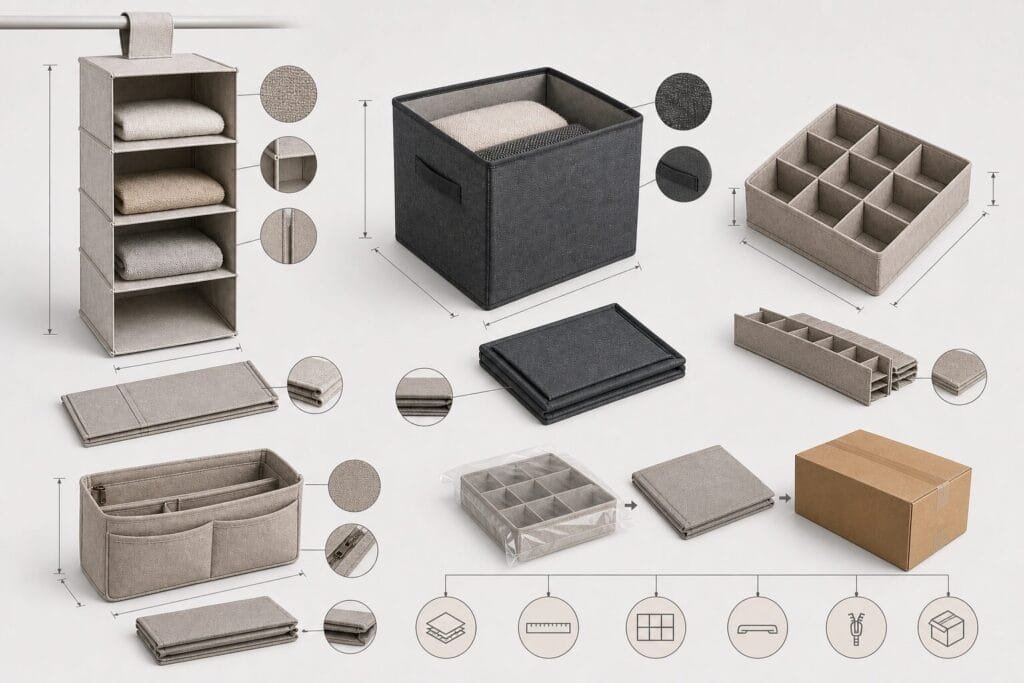
Retail buyers searching for custom closet organizers from China are usually not looking for generic home organization tips. They need a practical way to compare suppliers, prepare an RFQ, and avoid unclear specifications before ordering samples or bulk production. This article works as a sourcing checklist for OEM/ODM closet storage organizers, covering the questions buyers should confirm before sampling or bulk orders. The most important questions are about product structure, material, size, logo options, packaging, MOQ, sample process, quality control, and how the manufacturer handles OEM or ODM requirements.
For importers, private label brands, wholesalers, and home organization product distributors, a closet organizer is not just a storage item. It is a retail SKU that must fit shelf strategy, target price, packaging format, shipping method, and end-user expectations in markets such as the United States, Europe, Japan, and South Korea. Before you ask for a quotation, you should give the supplier enough information to recommend a workable structure and confirm which details still need sampling.
Great Shine Home Storage Supplier supports B2B buyers sourcing closet storage organizers, handbag organizers, fabric storage products, and other custom home storage items. The checklist below is designed to help sourcing managers prepare a clearer inquiry before contacting a China closet organizer manufacturer.
1. What Product Type Are You Ordering?
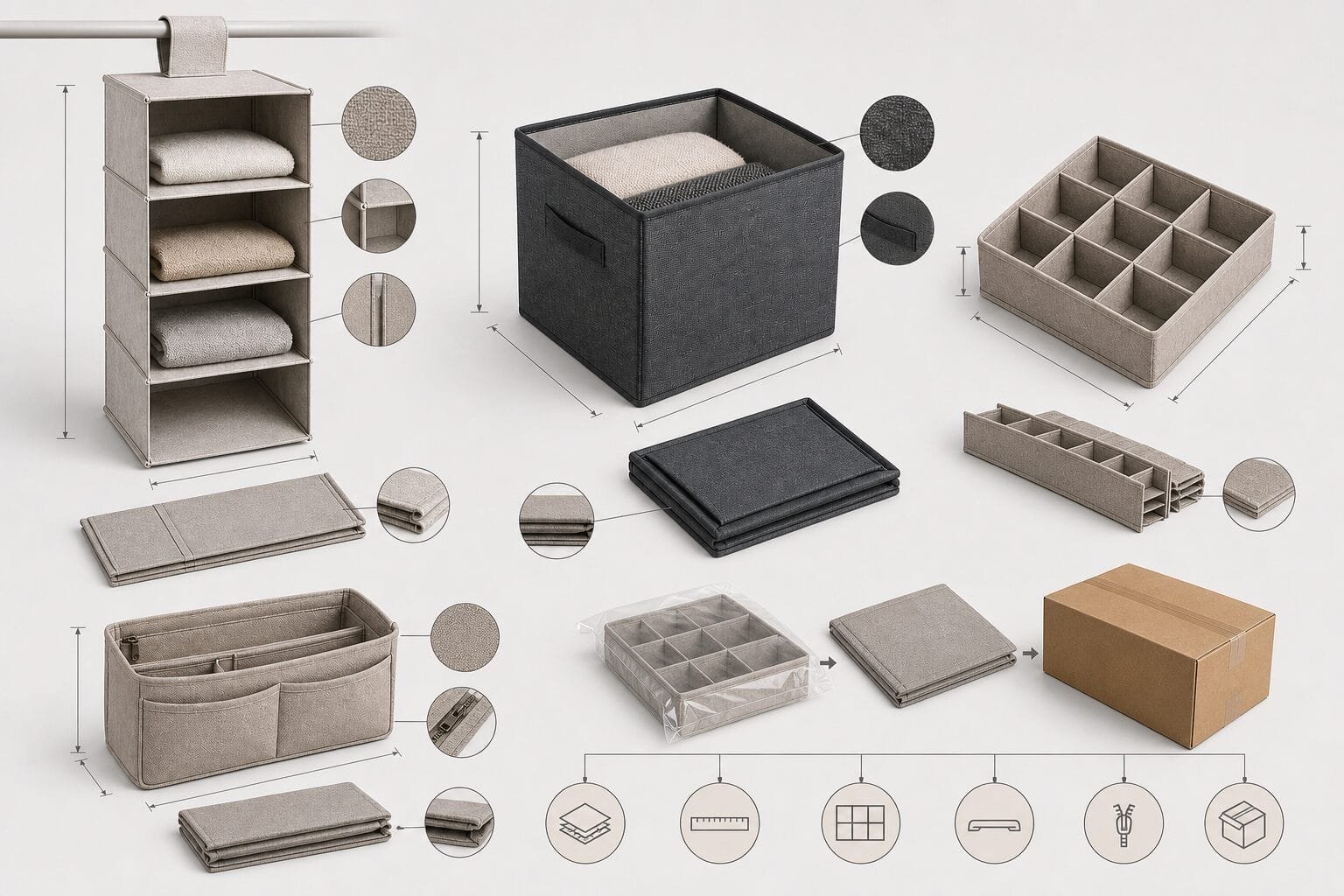
The first question is simple but often overlooked: what kind of closet organizer do you need?
“Closet organizer” can refer to several product structures, including foldable closet shelves, hanging wardrobe organizers, drawer-style bins, trapezoid storage bins, handbag organizers, leggings organizers, non-woven storage bags, or modular fabric organizers. Each type has different material needs, packing volume, and quality risks.
Before contacting a supplier, define the product family clearly. For example, a hanging organizer needs questions about load-bearing structure, hook design, stitching, shelf reinforcement, and folding method. A fabric closet bin needs questions about shape retention, handle strength, inner board, fabric thickness, and whether the design should collapse for shipping. A handbag organizer needs questions about pocket layout, hanging method, transparent panels, and dust protection.
If your buying team is still comparing options, send reference photos, target retail channel, expected retail price level, and intended user scenario. A supplier can then suggest whether the project is better developed as an OEM order based on an existing style or an ODM project with more structural changes.
2. Which Specs Should Be Confirmed Before the RFQ?
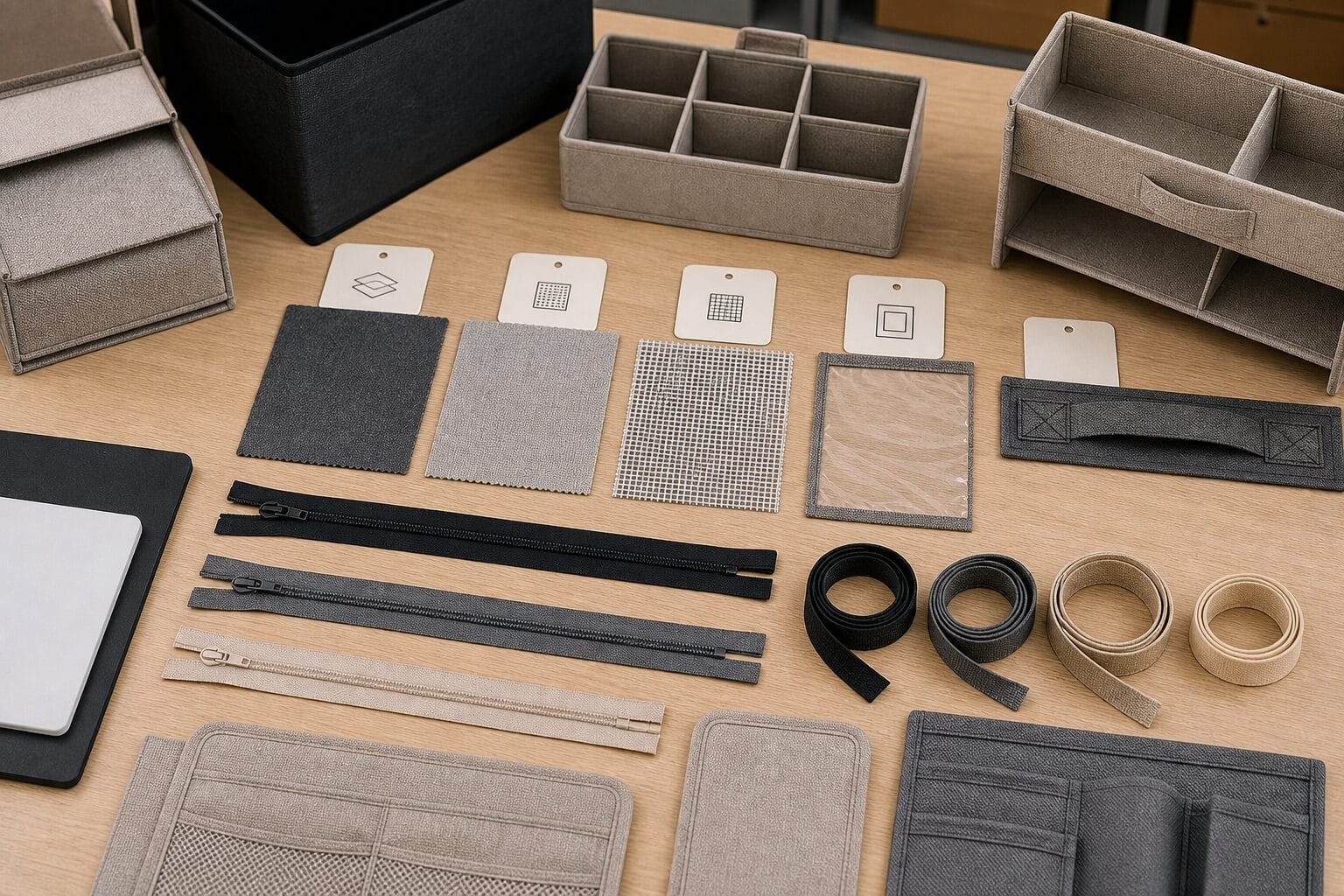
A strong RFQ for custom closet organizers from China should include more than a product name and estimated quantity. The supplier needs enough detail to evaluate materials, labor, packaging, and sampling requirements.
Key specifications include:
- Product type: hanging organizer, foldable shelf, storage bin, handbag organizer, drawer organizer, or another closet storage format.
- Size: length, width, height, number of compartments, and folded size if relevant.
- Material: non-woven fabric, polyester, Oxford fabric, PVC window, mesh, cardboard insert, plastic board, metal hook, zipper, binding, or other components.
- Structure: collapsible, rigid, hanging, stackable, open-top, zippered, drawer-style, or compartment-based.
- Color and pattern: solid color, seasonal color, printed fabric, private label colorway, or retail collection match.
- Logo method: woven label, printed logo, heat transfer, patch, hangtag, packaging label, or no visible logo.
- Packaging: polybag, insert card, color box, belly band, mailer-ready packaging, carton packing, or retailer-specific packaging.
- Target market: US, EU, Japan, South Korea, or another destination market with its own retail preferences.
A clear spec sheet helps the supplier quote the same product your buyer expects. If details are still undecided, mark them as open questions instead of leaving them invisible. For example, ask, “Can you recommend a foldable structure suitable for e-commerce shipping?” or “Which material options are common for a mid-range retail closet bin?” For wholesale and private label development, review our custom closet organizer manufacturing program for hanging organizers, portable wardrobe structures, material options and retail packaging.
3. How Should Buyers Compare Materials and Structures?
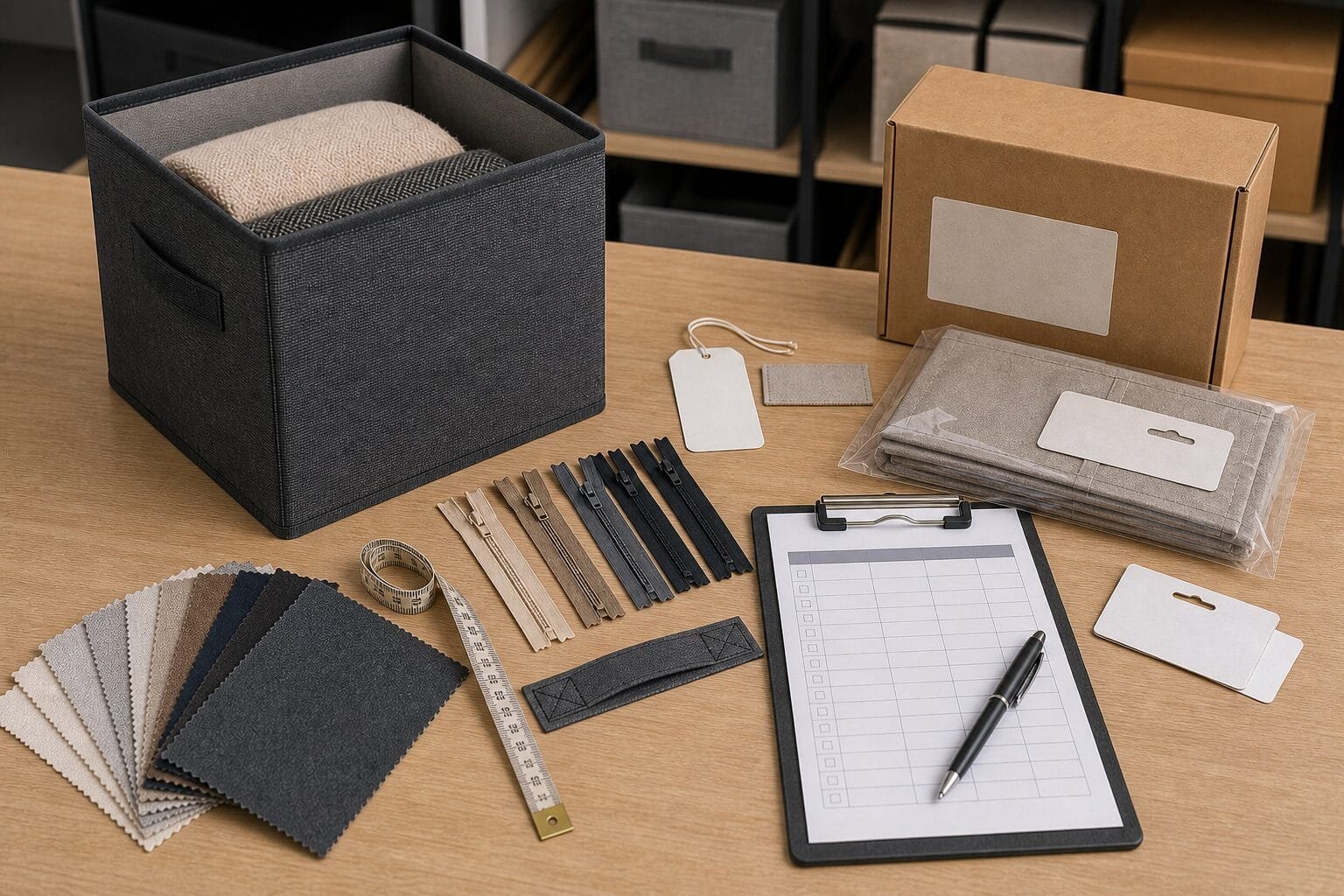
Material choice affects cost, product appearance, shelf feel, packaging size, and user experience. For custom closet organizers, buyers often compare non-woven fabric, polyester, Oxford fabric, mesh, PVC panels, and internal board materials. No single material is best for every order. The better question is which material fits the retail program.
| Decision Point | Lower-Cost Direction | Mid-Range Direction | Premium or Specialized Direction | Questions to Ask the Supplier |
|---|---|---|---|---|
| Outer fabric | Non-woven fabric | Polyester or blended fabric | Oxford fabric or customized textile | What fabric weights and colors are available for sampling? |
| Shape support | Lightweight cardboard insert | Thicker board or reinforced panels | Custom board structure or stronger frame | How does the organizer keep shape after folding and shipping? |
| Visibility | Open compartments | Mesh panels | Clear PVC window sections | Is the window material suitable for the target appearance and packing method? |
| Hanging function | Basic hook or loop | Reinforced hanging strip | Custom hook or stronger hanger design | What load and use scenario should be confirmed during sampling? |
| Branding | Hangtag or sticker | Woven label or printed logo | Custom packaging and coordinated trim | Which logo methods fit the material and order quantity? |
| Packaging | Individual polybag | Insert card or belly band | Retail box or private label packaging | What packing format reduces damage and fits retail display needs? |
Buyers should avoid choosing material only by unit price. A cheaper fabric may reduce cost but create a less stable retail product. A stronger material may look better but increase folded thickness, carton volume, or sample development time. Ask the manufacturer to explain the tradeoff between material, structure, packaging, and target retail price.
4. What Customization Questions Matter Most?
For private label closet organizers, customization is not limited to adding a logo. Retail buyers often need custom size, color, compartment layout, packaging, barcode label, carton mark, and sometimes a full product family that matches other home storage SKUs.
Ask these questions before sampling:
Can the size be customized?
Custom size is important when the organizer must fit standard wardrobes, shelves, cube storage systems, apartment closets, or localized retail expectations. Provide the finished product dimensions and tolerance expectations if your company has them. If not, ask the supplier which common size ranges are practical for the chosen structure.
Can the compartment layout be changed?
Closet organizers may need different shelf heights, pocket counts, drawer depths, or handbag slot spacing. Changes that look small on a drawing can affect cutting patterns, sewing steps, material usage, and stability. Confirm whether your desired layout can be made from an existing pattern or requires new development.
Which logo methods fit the product?
A woven label may work well for fabric organizers. Printing may fit some flat panels. Hangtags or packaging labels may be better for buyers who want subtle branding. Do not assume every logo method works on every material. Ask for the available logo methods and what artwork file format the supplier needs.
What packaging can be private labeled?
Packaging is often the first branded touchpoint in retail. Ask whether the supplier can support insert cards, color boxes, belly bands, hangtags, carton marks, or other private label packaging. Also confirm what packaging information the buyer must provide, such as barcode, SKU code, warning text, language requirements, recycling marks, or retailer layout rules.
Great Shine also supports broader OEM and ODM private label bag manufacturing for buyers who need coordinated materials, logo, labels, and packaging across related storage product lines.
5. What Should Buyers Ask About MOQ, Samples, and Bulk Orders?
MOQ, sample time, and production lead time should not be guessed. They depend on material availability, customization level, packaging complexity, order quantity, and whether the product is based on an existing design or a new structure. Because exact terms are project-specific, buyers should ask direct questions instead of assuming standard answers.
Useful questions include:
- What is the MOQ for this style with standard material and color?
- Does the MOQ change for custom color, custom print, or private label packaging?
- Can you make a sample from an existing style before full custom development?
- What sample cost should be confirmed for this project?
- What information do you need before making a pre-production sample?
- What is the expected sample timeline for the selected material and logo method?
- What factors may affect bulk production time?
- Can the supplier confirm carton size, packing quantity, and gross weight before shipment planning?
For retail buyers, the goal is not only to get a low MOQ. The goal is to confirm whether the supplier’s MOQ and development process fit your launch calendar, buying plan, and forecast confidence. If your brand is testing a new SKU, ask whether an existing structure can reduce development risk. If your retailer requires a custom package, confirm packaging artwork and approval steps early.
6. What QC Details Should Be Checked for Closet Organizers?
Quality control for closet organizers should focus on practical construction points. Avoid relying only on product photos. Ask the supplier what can be checked during sampling and before shipment.
Important QC questions include:
- Are stitches straight and reinforced at stress points?
- Are handles, hanging loops, hooks, or straps suitable for the intended use scenario?
- Does the organizer hold its shape after folding, packing, and opening?
- Are zippers, Velcro, snaps, or closures smooth and correctly aligned?
- Are panels, compartments, and pockets consistent in size?
- Is the fabric color consistent across production pieces?
- Does the product have sharp edges, loose threads, odor concerns, or visible glue marks?
- Does the packaging protect the product during carton shipping?
- What inspection standard or checklist should the buyer confirm before production?
These questions do not require the supplier to claim unsupported test results. They help both sides define what “acceptable quality” means for the order. If your company has its own AQL standard, inspection checklist, packaging drop-test requirement, or retailer compliance document, share it before quotation or at least before bulk production approval.
7. Buyer Checklist Before Sending an Inquiry
Use this checklist before asking for a quote from a custom closet organizer supplier in China:
- Confirm the exact product type: hanging organizer, closet bin, handbag organizer, shelf organizer, or drawer-style organizer.
- Prepare product dimensions or ask for recommended common sizes.
- Decide whether the project is OEM based on an existing style or ODM with custom structure development.
- List preferred materials and acceptable alternatives.
- Confirm color, pattern, trim, and logo requirements.
- Decide whether private label packaging is needed.
- Prepare target quantity and forecast range, even if final order quantity is not fixed.
- State the target market, such as the US, Europe, Japan, or South Korea.
- Ask what MOQ, sample cost, sample timeline, and production timeline need confirmation.
- Request carton packing information for freight planning.
- Share any retailer packaging, labeling, inspection, or compliance requirements you already have.
- Ask what details are missing before the supplier can quote accurately.
A complete inquiry saves time for both the buyer and the manufacturer. It also reduces the risk of receiving quotes for different product assumptions.
8. When Should You Request a Quote from Great Shine?
You should request a quote when your team has a target product type, approximate size, estimated quantity, material direction, and customization needs. You do not need to have every detail finalized. In many sourcing projects, the supplier helps refine the product structure after reviewing the buyer’s target market and retail channel.
Great Shine can be a useful sourcing partner when your program involves custom closet organizers, handbag organizers, fabric storage bins, home storage bags, or related private label storage products. Buyers can start from the closet storage organizers category or review related handbag organizers if the project is focused on wardrobe accessories.
For broader custom storage and bag programs, visit the custom bag manufacturer page. To discuss a specific closet organizer order, send your product type, size, material, logo, packaging, and target quantity through the Great Shine contact page. The more complete your RFQ, the easier it is to receive practical customization suggestions.
FAQ
What information should I send when requesting custom closet organizers from China?
Send the product type, dimensions, material preference, structure photos or drawings, quantity, target market, logo method, packaging requirements, and any inspection or retailer requirements. If some details are undecided, ask the supplier to recommend practical options.
Can closet organizers be made as private label products?
Yes, many closet organizers can be developed for private label programs with custom size, color, label, logo, hangtag, insert card, carton mark, or retail packaging. The exact options depend on product structure, material, order quantity, and packaging design.
What is the difference between OEM and ODM closet organizers?
OEM usually means producing based on an existing or buyer-provided design with specified materials, size, and branding. ODM usually involves more product development, such as adjusting structure, compartments, materials, or packaging to create a more customized retail SKU.
How do I compare closet organizer suppliers?
Compare suppliers by product category fit, material options, customization support, sample process, packaging capability, communication quality, QC checklist, and ability to answer technical sourcing questions. Do not compare only by unit price.
What quality points are important for fabric closet organizers?
Important points include stitching, shape support, fabric consistency, handle strength, hanging structure, compartment accuracy, zipper or closure function, folding performance, and packaging protection. Buyers should confirm inspection expectations before bulk production.
When should I contact Great Shine for a quote?
Contact Great Shine when you have a target product type, approximate size, order quantity, material direction, and customization needs. If you are still deciding between structures, share reference images and your target retail market so the team can suggest practical options.
Request a Quote
If you are preparing a closet organizer program for retail, wholesale, import, or private label sales, send your RFQ details to Great Shine. Include product type, size, material, color, logo, packaging, target quantity, and destination market. Start from the contact page to request customization suggestions and a project quote.